
From 2.8 GW to 150 GW: India’s solar power story in numbers
Solar energy adoption is turning out to be a game changer for India. There was a time when solar power was restricted to rooftops and a few isolated mini-micro grids. The government was more focused on doubling coal output by 2020 and enhancing gas-based generation, and solar was a low priority despite rising CO₂ emissions and visible climate change.
That calculus has shifted dramatically. India’s electricity demand continues to grow by more than 6% each year, and the country’s sunny climate made it increasingly favourable to adopt solar and tap other renewable sources, wind, hydroelectric, nuclear, tidal. With India’s economy now growing faster than China’s, the urgency to electrify at scale has become undeniable.
The scale of what is being built
Nowhere captures the ambition better than Khavda, in the Rann of Kutch. The government’s 2023 decision to permit construction within six miles of the Pakistan border paved the way for Adani to gain control of land there. By 2029, nearly 60 million panels will cover 208 square miles of one of the world’s largest salt deserts, extending right up to the border with Pakistan. The Khavda solar park is set to be the world’s largest solar power facility, with a generating capacity of 30 gigawatts, roughly 30 times the size of a typical coal or nuclear power station. Its panels are attended by robots that dry-clean them at night, removing desert salt and dust without using precious freshwater.
India’s installed solar capacity has been growing by roughly 40% a year. According to the Global Solar Market Outlook 2026–2030 published by SolarPower Europe and the National Solar Energy Federation of India (NSEFI), India added a record 39.6 GW of solar capacity in 2025 alone, nearly doubling the previous year’s additions. By March 2026, cumulative installed capacity had crossed 150 GW, a more than 50-fold increase since 2014, when the country had just 2.8 GW. Solar now accounts for over 54% of India’s total renewable energy capacity, and the country has crossed 50% non-fossil installed capacity five years ahead of its 2030 target.
The same report projects India’s solar capacity will reach between 325 and 385 GW by 2030, likely outperforming the government’s own target of 280–300 GW.
The grid problem
Yet solar last year made up 28% of India’s total installed electricity-generating capacity while accounting for only 9.4% of the electricity put into supply. The gap between capacity and output is largely a grid problem. India’s transmission infrastructure cannot yet carry all the solar power being captured in the deserts of western India to where it is needed in urban and industrial centres. At times last year, almost 40% of the country’s solar power output did not reach customers.
Solar plants typically take 18 to 24 months to build, while transmission projects usually take about five years. The grid is trying to catch up. The Ministry of New and Renewable Energy has allocated more than $100 billion to expand the national grid by 29% by 2032, through a series of green energy corridors linking solar hubs to major industrial and population centres. In FY 2024–25, approximately 8,830 circuit kilometres of new transmission lines were added, with a further 5,077 circuit kilometres added between April and December of FY 2025–26 (NSEFI / SolarPower Europe).
The storage imperative
India also lacks the infrastructure to store renewable energy to meet demand after the sun goes down and through the cloudier monsoon season. Two solutions are being pursued simultaneously: pumped storage and battery storage.
Pumped storage works by linking two reservoirs at different elevations. When the grid has surplus power, electricity pumps water from the lower tank to the upper one. When extra power is needed, water drops through turbines back to the lower tank. The Central Electricity Authority has identified 120 potential pumped-storage sites with a combined capacity of 180 GW. A 1.4 GW project is expected to pump water from the Gandhi Sagar reservoir on the Chambal River in Madhya Pradesh. Another, with a capacity of 3 GW, is set for completion near Mumbai in 2030. The India Energy Storage Alliance (IESA), in a white paper released at the Stationary Energy Storage India (SESI) 2026 conference, projects pumped hydro energy storage capacity will grow from 7 GW in 2025 to 107 GW by 2033.
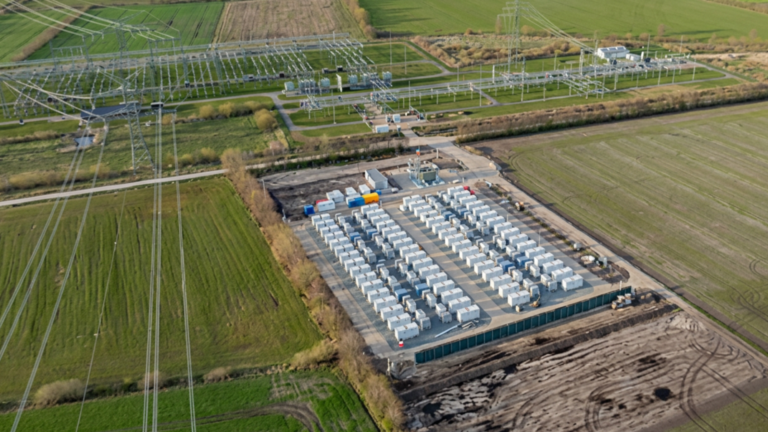
Battery storage is scaling rapidly alongside pumped hydro. As global battery costs fall sharply, lithium-ion systems are making round-the-clock solar power increasingly viable. Adani is currently assembling the country’s biggest battery storage system at the Khavda complex, enough to discharge over a gigawatt of power to the grid for three hours every evening.
The official data from the Central Electricity Authority (CEA), as of 31 May 2026, shows how quickly battery energy storage systems (BESS) are scaling up in India. Of the 157 projects tracked with a capacity of at least 1 MWh, 18 projects totalling 2,721 MW / 7,499 MWh are already in operation. A further 42 are under construction (15,259 MW / 41,539 MWh), 34 have been awarded (12,243 MW / 39,416 MWh), and 63 are in the tender stage (14,196 MW / 55,361 MWh). Total pipeline capacity stands at over 44,000 MW and 143,000 MWh across all categories.
The pace of tendering has accelerated sharply. The IESA-CES white paper released at SESI 2026 reported 69 new BESS tenders totalling 102 GWh launched over the past year, a 35% increase over 2024 and nearly double the annual tender volume of the year before. The report projects installed stationary storage capacity will reach 346 GWh by 2033 under a base scenario, rising to 544 GWh if policy momentum is sustained.
S.C. Saxena, chairman and managing director of GRID India, noted at the white paper launch that large-scale energy storage has become essential for grid resilience, given that demand can swing by up to 90 GW. Debmalya Sen, president of IESA, said the white paper provides the strategic clarity India needs to reach its target of 500 GW of non-fossil generation by 2030, with storage as the backbone of a flexible grid.
Policy has played a significant role in driving this momentum. The IESA-CES report attributes the acceleration to Energy Storage Obligations (ESO), Viability Gap Funding (VGF), formal recognition of storage in India’s Electricity Amendment Rules 2025, and full waivers on interstate transmission system (ISTS) charges, all of which have strengthened investor confidence and project bankability. VGF schemes specifically for BESS include 3,760 crore rupees for 4,000 MWh of capacity and an expanded 5,400 crore rupees for 30 GWh.
The China dependency
India remains heavily dependent on China for the technology behind its solar push. The silicon materials that make photovoltaic cells largely originate in China. To reduce this dependence, the government has given a significant push to domestic manufacturing through the Production Linked Incentive (PLI) scheme, Basic Customs Duty (40% on modules, 25% on cells), and the Approved List of Models and Manufacturers (ALMM). Domestic module manufacturing capacity reached 144 GW by end of 2025 and 172 GW by March 2026 (NSEFI / SolarPower Europe). With ALMM List-II for solar cells coming into force from June 2026 and ALMM List-III for wafers and ingots expected by June 2028, the supply chain is being progressively deepened, though upstream segments like wafers and polysilicon remain limited.
Electrifying transport
Despite its limitations, solar power is well-positioned to cater to the vast majority of India’s electricity requirements through the mass deployment of panels and batteries. India is emphasising the electrification of transportation. Over 42,000 miles of broad-gauge railway have been electrified. Fleets of buses, rickshaws, and private vehicles are being electrified, fully or on hybrid mode, as the network of recharging infrastructure is also being laid. The recent curtailment of oil and gas supplies from the Middle East will only further accelerate the country’s shift toward electric transport.
What this means for the world
Despite its drawbacks, the rapid advance of Indian solar power continues. India aims to complete its transition into a modern industrial economy by 2047, the centenary of its independence. A country of 1.4 billion people showing that solar and storage can underwrite industrial-scale economic growth is itself a proof of concept the rest of the world is watching closely. Whether India succeeds, or fails, will shape the global energy transition for decades to come.
About the author: Rajendrasinh Parmar is a retired Executive Engineer from GSECL with over 30 years of experience in power plant operations, commissioning, and ERP-driven business transformation. A Mechanical Engineer and MBA, he now mentors thousands of young professionals through voluntary career guidance and motivational initiatives.




Great case study of Solar energy future of India energy-economy boost ing media. Mr Rajendrasinh Parmar have good & depth experience in power industry also helping to thoughts of technical professional in india. Thank you
Great case study of Solar energy future of India energy-economy boost ing media. Mr Rajendrasinh Parmar have good & depth experience in power industry also helping to thousands of technical professional in india. Thank you
Sir, it very good and knowledge sharing article which is touched upon all the aspects of Solar leap of India with BESS & Transmission network
In depth knowledge of current and future scenario of Solar Energy which gives clarity. Keep it up.
We are proud of you as one of the Obssans.