
CEA sets 2028-29 target for indigenous SCADA and EMS systems
The Central Electricity Authority (CEA) has outlined a phased roadmap for the indigenous development of Supervisory Control and Data Acquisition (SCADA) and Energy Management System (EMS) solutions for the power sector, with full indigenisation targeted by 2028-29. The roadmap covers 38 software modules and 25 hardware modules and is aimed at strengthening grid-management capabilities as India integrates increasing amounts of renewable energy.
The initiative follows a directive issued at the Prime Minister’s sectoral review meeting in December 2025, which identified SCADA indigenisation as a priority for improving self-reliance and cyber-resilience. The Ministry of Power subsequently mandated that SCADA systems would not be imported beyond 2030 and tasked CEA with developing an indigenisation trajectory in consultation with stakeholders.
SCADA systems provide real-time monitoring and control of generation, transmission and distribution across the National Power Grid. According to the report, dependence on foreign original equipment manufacturers (OEMs) and proprietary technologies has created interoperability constraints, delayed customisation and limited flexibility, while also raising potential risks to national energy security amid an evolving geopolitical environment.
Development roadmap
The committee has divided the development of the 38 software modules into three phases through March 2029. Core SCADA, communication, historian, web application and cybersecurity functions are targeted for 2026-27. These include SCADA, ICCP, CFE, Historian, Web Server, SMS/Email Interface, Identity Management, NAC, Patch Management, VAPT, HIPS, Endpoint Security and Centralised Log Analyser.
The 2027-28 phase covers advanced EMS functions, including State Estimator, Contingency Analysis, Security Enhancement, Optimal Power Flow, Short Circuit Analysis and Automatic Generation Control (AGC). The final phase in 2028-29 covers advanced operational functions, including Transmission Line/Corridor Capability Monitor, Outage Scheduler, Dynamic Security Assessment (DSA) at the Regional Load Dispatch Centre (RLDC) and Dispatcher Training Simulator.
The hardware roadmap covers 25 items, including servers based on the Rudra platform, workstations, storage systems, network switches, firewalls, Remote Terminal Units (RTUs), GPS clocks and video projection systems. For information technology hardware and telecommunications/networking equipment, where the power sector represents a relatively small user base, the committee has recommended following Make in India trajectories defined by the Ministry of Electronics and Information Technology (MeitY) and the Department of Telecommunications.
Renewable integration
The roadmap gives particular importance to load forecasting and advanced EMS functions as renewable energy penetration increases. Load forecasting and core SCADA functions are scheduled for 2026-27, followed by state estimation, contingency analysis, security enhancement, optimal power flow and AGC in 2027-28.
Transmission line and corridor capability monitoring and outage scheduling are scheduled for 2028-29. DSA at the RLDC level is proposed for 2027-28.
These functions are intended to improve grid operators’ ability to assess system conditions and manage generation and demand in real time while maintaining frequency, voltage and power-flow parameters within prescribed limits. The capabilities are particularly relevant as renewable generation capacity expands in locations that are distant from major demand centres.
Institutional model
To drive the indigenisation programme, the committee has proposed formalising an institutional framework through either a National SCADA Mission or a specialised Working Group under the Ministry of Power or CEA.
For development and integration of SCADA components, the report has proposed two models. Under the nomination-based model, government public sector undertakings (PSUs) with SCADA experience, such as C-DAC, may be nominated for the work. Under the collaboration or consortium model, PowerGrid or GRID-INDIA may initiate an expression of interest process within one year.
Testing and pilots
The committee has identified dedicated funding and testing infrastructure as important requirements for meeting the proposed development timelines. It has recommended establishing a testing platform for indigenous SCADA modules through simulation and cybersecurity validation within two years, with government funding.
It has also proposed pilot projects at State Load Dispatch Centre (SLDC), RLDC and National Load Dispatch Centre (NLDC) levels for real-time field testing and validation of indigenous SCADA and EMS software and hardware. The pilot systems would operate in parallel with existing systems. SLDC Odisha has volunteered to provide a testing environment.
Cybersecurity
The report identifies cybersecurity and interoperability as key issues in the existing SCADA ecosystem. Dependence on foreign OEMs, proprietary technologies and difficulties in integrating systems from different vendors can restrict flexibility and create challenges for future system upgrades.
To address these issues, the committee has recommended standardised, Common Information Model (CIM)-based information models, open interfaces and modular architectures. The proposed approach is intended to reduce vendor dependence and make future upgrades easier.
The committee concluded that India has the technical capability to indigenise SCADA systems during the 2026-27 to 2028-29 period, subject to adequate funding, development of a testing ecosystem and implementation support. For renewable energy integration, the roadmap brings together forecasting, AGC, state estimation, optimal power flow, security assessment and transmission-capability monitoring to provide grid operators with the digital capabilities required to manage a more complex generation and transmission system.
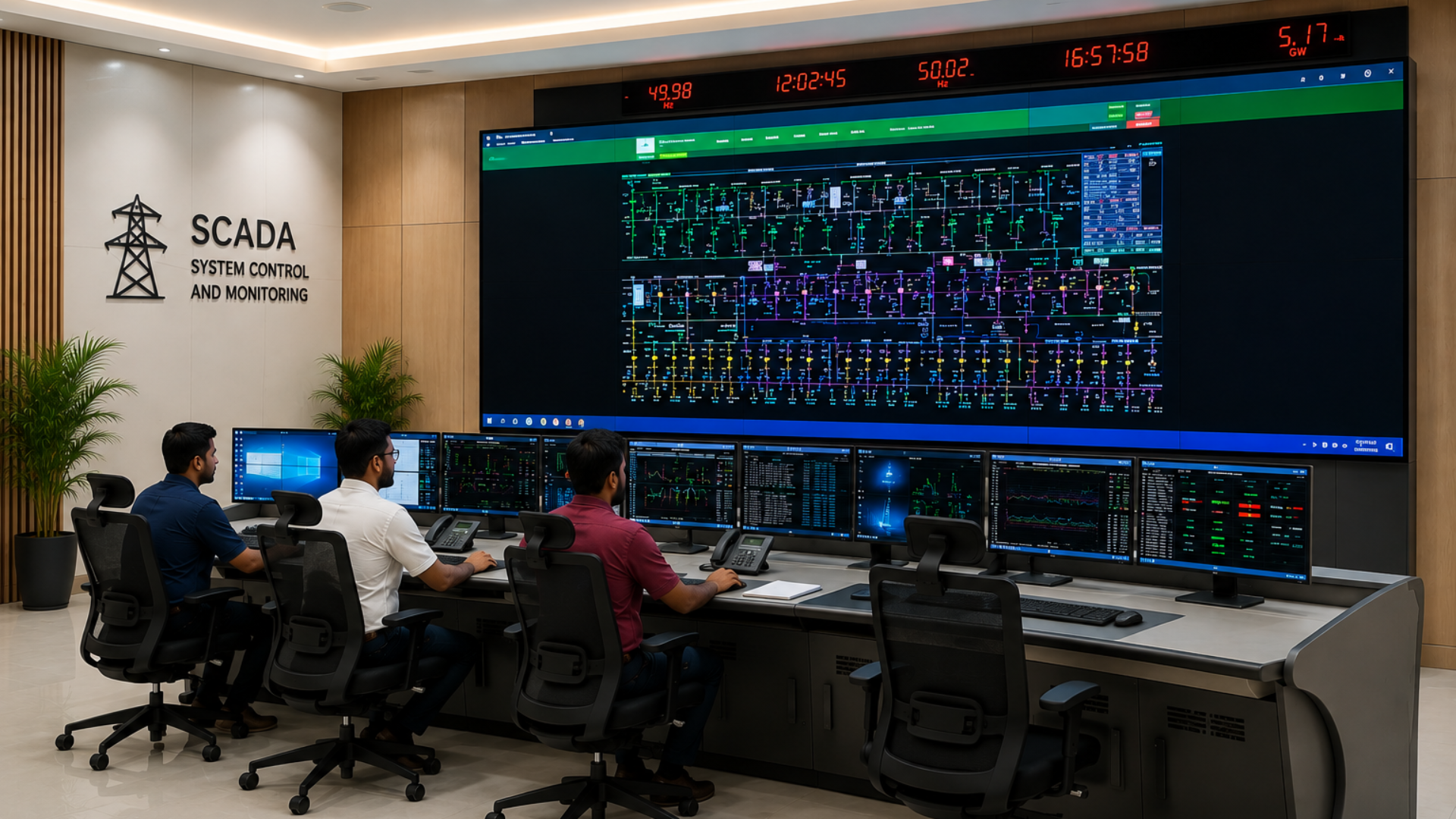
The featured photograph is for representation only.