Punjab, IISc collaborate on green hydrogen pilot using paddy straw
Author: PPD Team Date: October 13, 2025
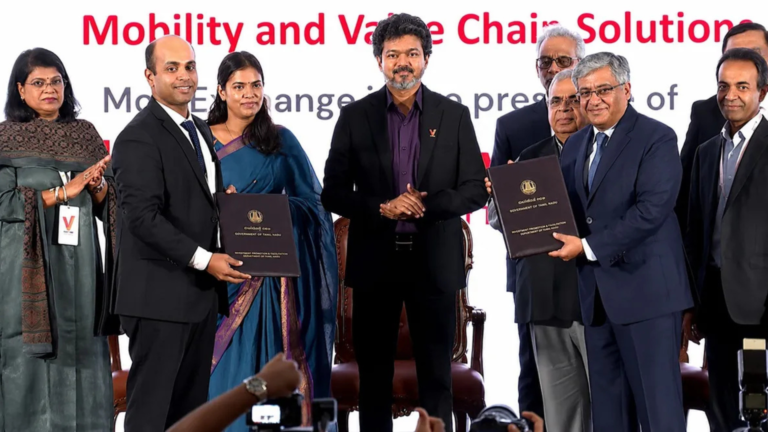
The Punjab Energy Development Agency (PEDA) has signed a memorandum of understanding (MoU) with the Indian Institute of Science (IISc), Bengaluru, to launch a pilot project for producing green hydrogen from biomass, specifically paddy straw.
The initiative aims to reduce stubble burning, improve air quality, and create additional income opportunities for farmers. It is also expected to generate employment in the green energy sector.
In July 2025, IISc researchers developed a system capable of producing over 99 per cent pure green hydrogen from agricultural waste. The system can generate five kgs of hydrogen per hour from farm residue that would otherwise be burned or release methane.
The MoU was signed by Neelima, CEO of PEDA, and the registrar of IISc, Bengaluru, with Prof. S. Dasappa from IISc’s Interdisciplinary Centre for Energy Research (ICER) witnessing the exchange. The event took place during the 5th International Conference on Recent Advances in Bio-Energy Research at the Sardar Swaran Singh National Institute of Bio-Energy (SSS-NIBE).
By converting paddy straw into green hydrogen, the project seeks to provide a sustainable solution to Punjab’s stubble-burning problem. The initiative is expected to benefit both the environment and local communities by turning agricultural waste into energy.
Author: PPD Team Date: October 23, 2025 The Ministry of New and Renewable Energy (MNRE) has issued a clarification on the applicability of the Solar Systems, Devices and Components Goods Order, 2025, dated January 27, 2025. The clarification, released on October 21, 2025, addresses queries related to item number 3 of the order, which covers storage batteries. According to MNRE’s Standard and Quality Control Division, the Quality Control Order (QCO) applies to all types of…
Author: PPD Team Date: December 27, 2024 Avaada Energy Private Limited plans to raise Rs 84 billion (USD 1 billion) in debt by March 2025 to fund its wind, solar, and other renewable projects. Equity for these projects has already been secured. The company also intends to develop pumped storage projects (PSPs) in Rajasthan and Odisha.
Author: PPD Team Date: January 22, 2025 CtrlS Datacenters plans to establish a 600 MW IT load capacity datacentre park across 40 acres at Chandanvelly Industrial Park, Hyderabad. The first phase has secured 250 MW of sanctioned power, with plans for a dedicated gas-insulated substation (GIS), expandable to 900 MW. The facility will feature high-density, AI-ready interconnected data centres that can support up to 135 KW per rack and immersion cooling up to 300 KW…
Author: PPD Team Date: February 3, 2025 Damodar Valley Corporation (DVC) and Haryana Power Purchase Centre (HPPC) signed a 25-year Power Purchase Agreement (PPA) to supply 800 MW of power from 2028-29 through three thermal power projects (TPPs) in Haryana on January 29, 2025. The bifurcated quantity to be supplied from projects are – 300 MW from Raghunathpur Power Project Phase II: The project involves Phase II expansion of the Raghunathpur Thermal Power Plant in…
Author: PPD Team Date: January 20, 2026 BluPine Energy, a renewable energy platform owned by private equity firm Actis, has secured a Rs 5,400 crore long-term loan facility underwritten by Axis Bank. The funding will be used to refinance existing debt across the company’s portfolio of operational renewable energy projects. The loan facility carries an interest rate of around 7.70% and has a tenor ranging from 16 to 20 years. It is secured against BluPine…
Author: PPD Team Date: April 24, 2025 The Ministry of Environment, Forest and Climate Change (MoEFCC) has issued a draft notification introducing the Greenhouse Gas Emission Intensity Target Rules, 2025, under the carbon credit trading scheme, 2023. These rules aim to reduce emissions in designated industrial sectors by setting specific emission intensity targets. Issued under the Energy Conservation Act, 2001, and the Environment (Protection) Act, 1986, the rules propose targets in terms of tonnes of…