
Central schemes: PM-KUSUM and PM Surya Ghar drive decentralised solar adoption
Author: PPD Team Date: March 4, 2026
Two central government programmes are expanding solar deployment beyond utility-scale projects by promoting generation at the farm and household level. The Pradhan Mantri Kisan Urja Suraksha evam Utthaan Mahabhiyan (PM-KUSUM) and PM Surya Ghar: Muft Bijli Yojana focus on decentralised solar installations that allow farmers and residential consumers to generate electricity directly at the point of use.
The Pradhan Mantri Kisan Urja Suraksha evam Utthaan Mahabhiyan (PM-KUSUM) integrates solar power into agricultural energy consumption. The scheme operates through three components: decentralised solar power plants on barren agricultural land (Component A), standalone solar pumps replacing diesel-powered irrigation pumps (Component B), and solarisation of existing grid-connected pumps (Component C).
As of January 31, 2026, renewable energy capacity installed under PM-KUSUM reached 10,949.46 MW, benefiting more than 23.14 lakh farmers. Installations across the scheme’s three components are shown below.
PM-KUSUM progress (as of January 31, 2026):

Component B has driven the largest deployment under the scheme. More than 10,05,898 diesel-powered irrigation pumps have been replaced with solar pumps, reducing operating costs for farmers and eliminating diesel consumption at the point of use. Component C has supported the solarisation of 13,08,361 grid-connected pumps, which helps reduce demand on distribution utilities during peak agricultural seasons.
Component A has progressed more slowly, with 765.33 MW installed against the target of 10,000 MW. Project implementation under this component depends on land availability, net-metering arrangements and coordination with distribution companies, which has slowed project approvals in several states.
State-level implementation varies significantly. Rajasthan has emerged as one of the leading states under PM-KUSUM, with 3,491.39 MW installed and around 2.76 lakh farmers participating in the programme. Maharashtra has received the largest share of funding, with Rs 4,515.89 crore released under the scheme.
At the same time, several states including Telangana, Andhra Pradesh, West Bengal, Bihar and Chhattisgarh have not received fund releases under PM-KUSUM, reflecting administrative and coordination challenges that affect implementation.
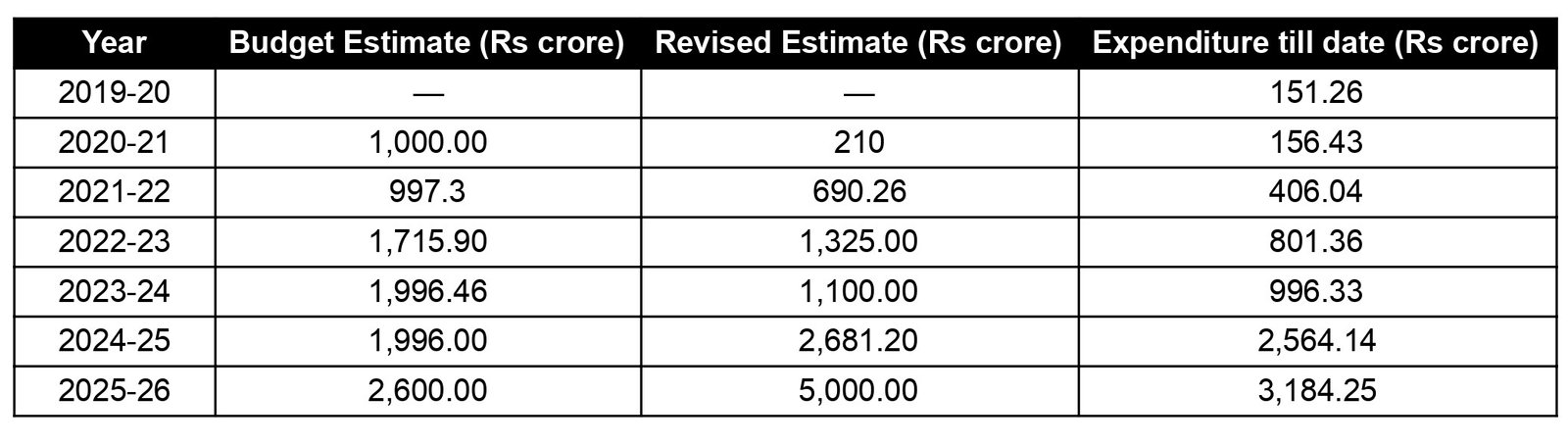
Funding under the scheme has increased steadily since its launch in 2019. The following table shows year-wise expenditure.
PM-KUSUM funds released since inception:
While PM-KUSUM targets the agricultural sector, PM Surya Ghar: Muft Bijli Yojana focuses on residential rooftop solar installations. The programme was launched in February 2024 to promote rooftop solar adoption through financial support for households installing solar systems.
The scheme aims to install rooftop systems in one crore households and add 30 GW of residential solar capacity by financial year (FY) 2026-27. The programme has a government outlay of Rs 75,021 crore.
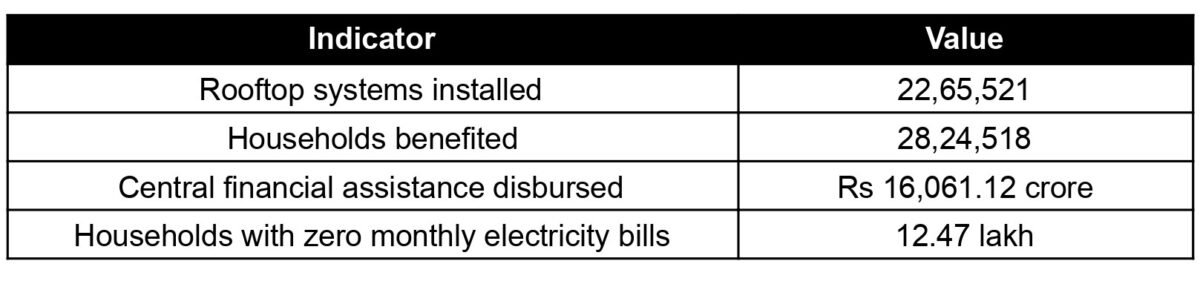
As of January 2026, 22,65,521 rooftop solar systems had been installed under the scheme. These installations have benefited 28,24,518 households, with Rs 16,061.12 crore disbursed as central financial assistance.
PM Surya Ghar progress (as of January 2026):
Adoption levels vary across states depending on administrative processes and implementation capacity. In Andhra Pradesh, 95,722 rooftop systems had been installed by early February 2026, benefiting 98,822 households.
Administrative reforms have been introduced to simplify the rooftop solar application process. Net-metering agreements have been integrated into the national application portal and automatic load enhancement of up to 10 kW has been introduced. These changes reduce procedural steps and shorten approval timelines for households installing rooftop systems.
Together, PM-KUSUM and PM Surya Ghar: Muft Bijli Yojana are expanding decentralised solar generation across agricultural and residential sectors. The schemes allow farmers and households to generate electricity locally while contributing to India’s broader renewable energy expansion.