
Solar plus storage can meet 90% of India’s demand at Rs 5.06/kWh: Ember
Author: PPD Team Date: April 8, 2026
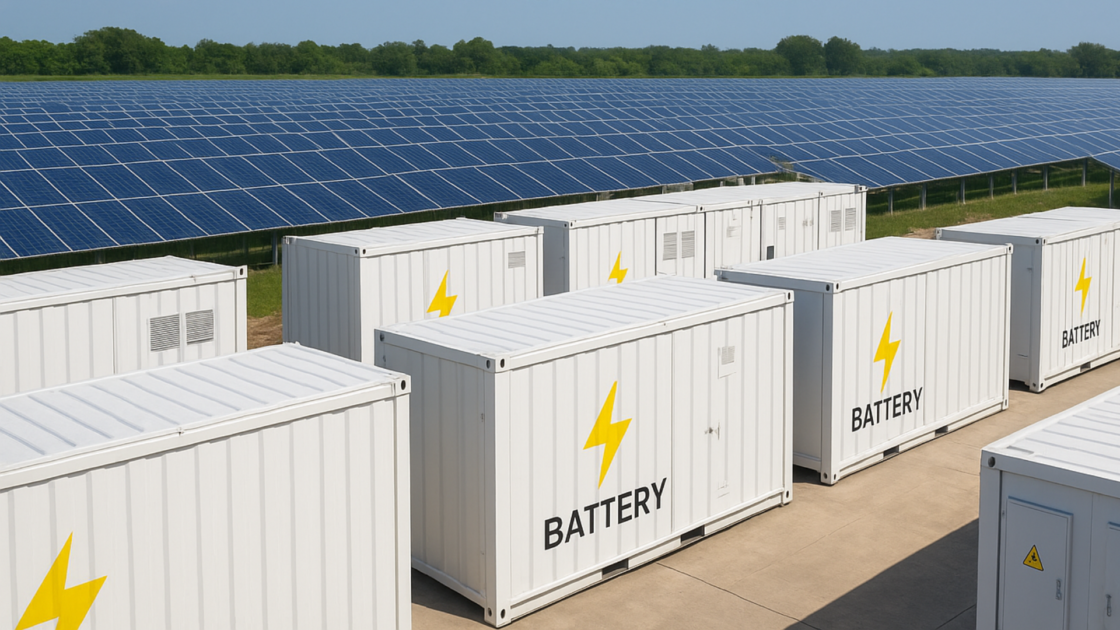
Solar power combined with battery storage can supply up to 90% of India’s electricity demand at a levelised cost of Rs 5.06 per kWh, according to a new analysis by Ember published on April 7, 2026. The study finds the model to be economically viable across most major states.
The report, titled “Battery storage is now cheap enough to unleash India’s full solar potential,” estimates that achieving this level would require 930 GW of solar capacity and 2,560 GWh of battery storage. This equates to 4.9 GW of solar and 13.5 GWh of battery for every 1 GW of average demand. Around 5% of annual solar generation would need to be curtailed. The analysis identifies prolonged periods of weak solar output, particularly during the monsoon, as the key operational constraint rather than day-to-night balancing.
Battery costs have declined sharply over the past two years. Turnkey battery costs fell by 40% in 2024 and a further 31% in 2025. Solar has been described by the International Energy Agency as the cheapest form of electricity since 2020. The report notes that solar-plus-storage auctions in 2025 cleared at Rs 2.9–3.5 per kWh for projects with four-hour battery capacity. India’s first solar project with six-hour battery energy storage system (BESS) capacity auction in early 2026 discovered a tariff of Rs 3.12 per kWh.
State-level outcomes vary under a uniform national configuration. Solar and battery systems could meet between 83% and 92% of electricity demand across the ten largest states by consumption. Seven states exceed 90%, with Andhra Pradesh at 92%, while Uttar Pradesh records the lowest share at 83%. States with higher demand during peak solar months perform better, while those with stronger monsoon-season demand, including Uttar Pradesh and West Bengal, show lower shares.
The modelled levelised cost of electricity (LCOE) is lower than current average power purchase costs in six of the ten largest states, averaging about 15% less. In Gujarat, the LCOE is 7% lower at Rs 5.05 per kWh compared with an average power purchase cost of Rs 5.45 per kWh. In Karnataka, the gap is wider at 21%, with LCOE at Rs 5.04 per kWh versus Rs 6.37 per kWh.
The report also notes rising coal-based generation costs. Recent coal plant auctions have discovered tariffs between Rs 5 and Rs 6.3 per kWh. These increases are linked to higher capital costs for pollution control equipment, declining coal quality, and higher maintenance needs due to deeper ramping requirements to balance variable renewable energy. Solar-plus-battery tariffs are typically fixed over the contract period, while coal tariffs are indexed to inflation.
The analysis is based on hourly electricity demand data for 2024 from the India Climate and Energy Dashboard and solar irradiation data from 15 locations across Gujarat, Rajasthan, Karnataka, Madhya Pradesh, and Andhra Pradesh.
The featured photograph is for representation only.