Non-fossil sources account for 53.6% of India’s installed power capacity
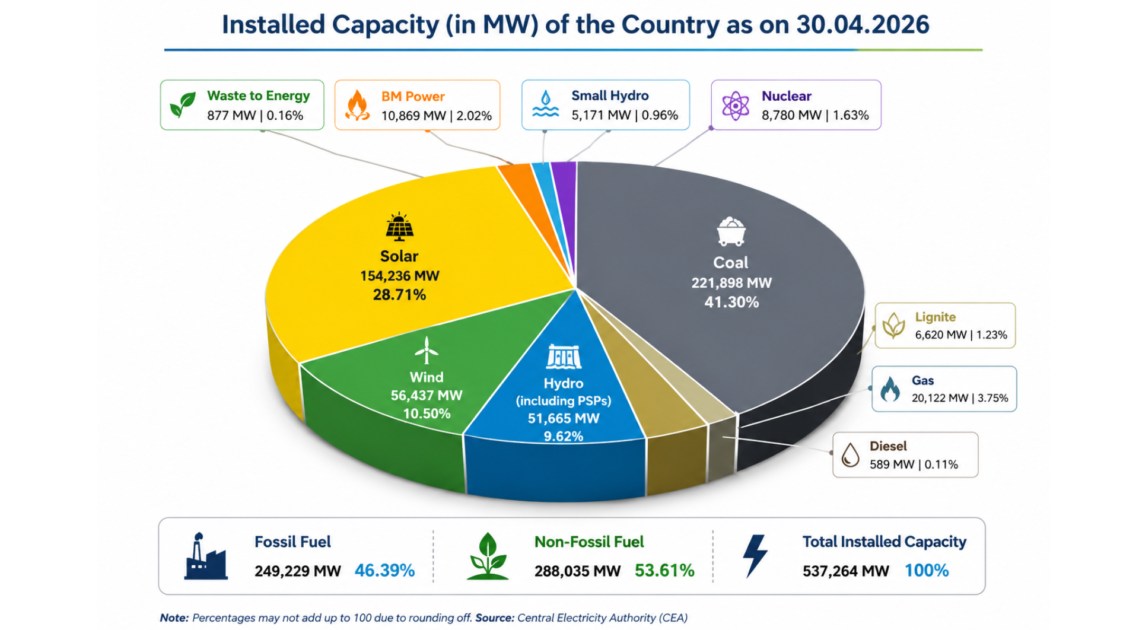
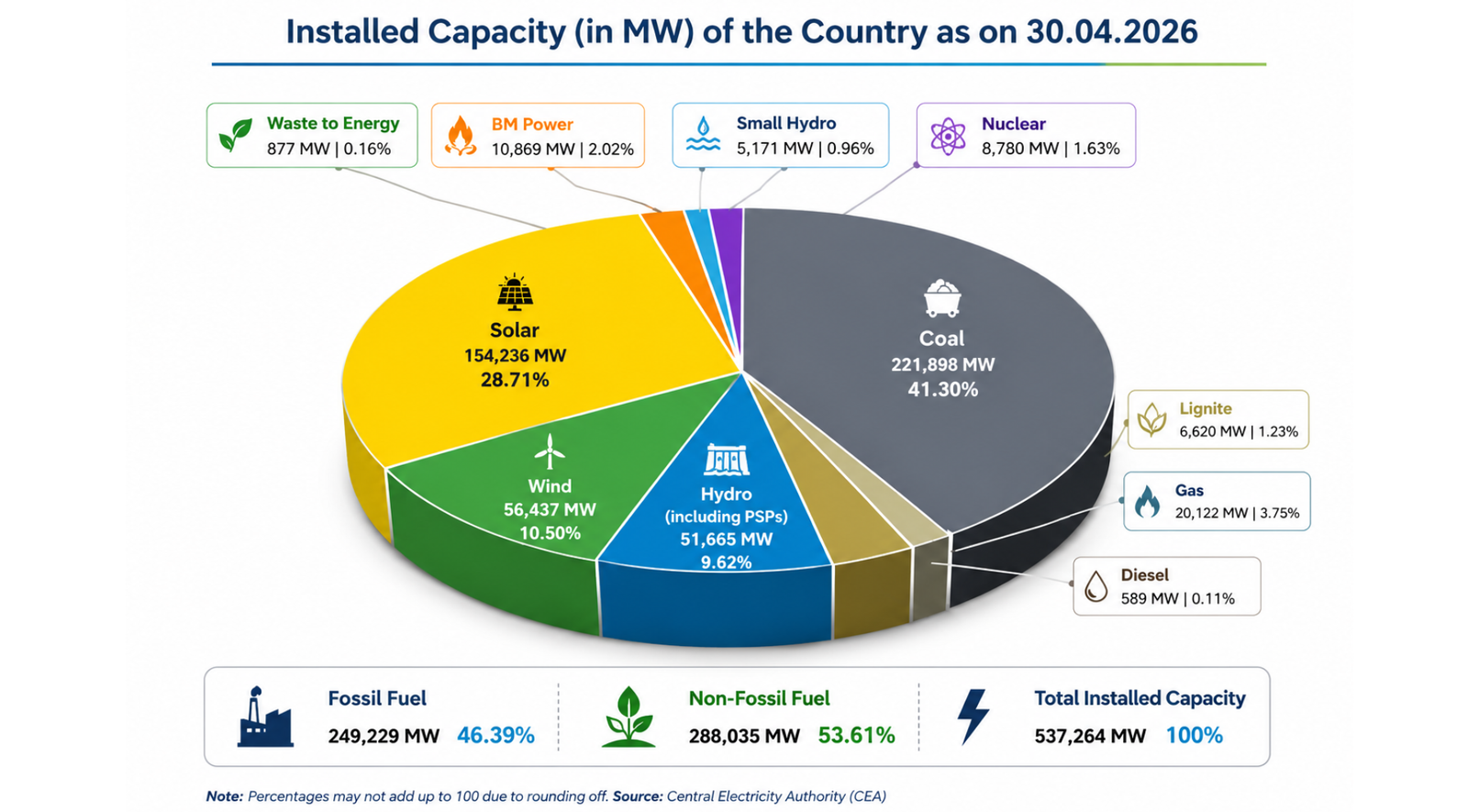
India’s total installed power generation capacity reached 537,264 MW as of April 30, 2026, according to the latest data released by the Central Electricity Authority (CEA). Non-fossil fuel-based sources, including renewable energy and nuclear power, now account for 53.61% of the country’s total installed capacity.
Capacity mix
The data shows that fossil fuel-based capacity stood at 249,229 MW, representing 46.39% of the total installed base. Coal continued to dominate the fossil fuel segment with 221,898 MW, followed by gas at 20,122 MW, lignite at 6,620 MW and diesel-based capacity at 589 MW.
Non-fossil fuel capacity reached 288,035 MW. This includes 51,665 MW of hydro power, including pumped storage projects (PSPs), 227,591 MW from wind, solar and other renewable energy sources, and 8,780 MW of nuclear power capacity.
Within the renewable energy segment, solar power remained the largest contributor with 154,236 MW, accounting for 28.71% of India’s total installed capacity. Wind power capacity stood at 56,437 MW or 10.50% of the total mix. Biomass-based capacity reached 10,869 MW, while waste-to-energy and small hydro contributed 877 MW and 5,171 MW, respectively.
Regional distribution
The Western Region remained the largest contributor to India’s installed capacity with 184,693 MW, followed by the Northern Region at 156,658 MW and the Southern Region at 149,965 MW. The Eastern Region accounted for 39,607 MW, while the North-Eastern Region and island territories contributed 6,177 MW and 164 MW, respectively.
Across most regions, the private sector accounted for the largest share of installed capacity. In the Western Region, private sector capacity stood at 103,914 MW, compared to 45,584 MW under the state sector and 35,195 MW under the central sector. In the Southern Region, private sector installations reached 86,583 MW against 40,096 MW in the state sector and 23,286 MW in the central sector.
The Northern Region recorded 83,290 MW under the private sector, 41,907 MW under the central sector and 31,461 MW under the state sector. In the Eastern Region, the central sector remained dominant with 19,649 MW.
Changes during April 2026
During April 2026, THDC India Limited added Unit 4 of the Tehri Pumped Storage Project with a capacity of 250 MW, effective April 9, 2026.
NTPC Limited also uprated Units 5 and 6 at the Dadri power station from 490 MW each to 500 MW each with effect from April 7, 2026.
At the same time, capacity retirements included Unit 1 of Telangana State Power Generation Corporation Limited’s Ramagundam-B Thermal Power Station, with a capacity of 62.5 MW, retired on April 7, 2026.
The CEA also recorded the retirement of seven units of the Pampore Gas Power Station operated by Jammu and Kashmir State Power Development Corporation. Each unit had a capacity of 25 MW, taking the total retired capacity to 175 MW. These units had already been temporarily removed earlier.
The report further noted that temporary removals effective May 31, 2025, continued to remain reflected in the April 2026 data. These include 1,995 MW of coal-based capacity, 4,225.84 MW of gas-based capacity and 100 MW of nuclear capacity that remain under prolonged outage. The CEA stated that such units would be added back to operational capacity once generation resumes and the authority receives formal intimation.
Based on the monthly changes, conventional power capacity additions during April 2026 stood at 207.5 MW, while renewable energy capacity additions reached 4,317.16 MW. Capacity retirements during the month totalled 20 MW, resulting in a net capacity addition of 4,524.66 MW.
The CEA noted that off-grid renewable energy capacity has been included in the installed capacity data since August 2021.
The latest figures underline the continuing shift in India’s power sector towards non-fossil fuel capacity additions, with renewable energy accounting for the bulk of incremental growth during April 2026. The data also reflects the increasing role of solar power in the country’s generation mix as utilities and developers continue expanding capacity to meet rising electricity demand and long-term clean energy targets.
Photo credit: AI-generated image