
GERC issues draft BESS regulations for Gujarat
Gujarat Electricity Regulatory Commission (GERC) has released the draft Gujarat Electricity Regulatory Commission (Grid Interactive Battery Energy Storage System) Regulations, 2026, proposing a detailed regulatory framework for deployment, operation and commercial utilisation of Battery Energy Storage Systems (BESS) across the state.
The draft regulations, notified on May 12, 2026, have been opened for stakeholder comments before final notification in the Gujarat Official Gazette.
Scope and applicability
The proposed regulations will apply across Gujarat to all grid-interactive BESS installations, including projects owned by generating companies, transmission licensees, distribution licensees, standalone developers, captive generating plants, prosumers and aggregators.
All BESS projects connected to the intra-state transmission or distribution network will require registration with Gujarat Energy Development Agency (GEDA), except where the storage system forms part of a new renewable energy project and is specifically included in the project registration.
Minimum project size and technical requirements
The draft regulations prescribe a minimum BESS project size of 1 MW with an energy storage duration of at least two hours and connectivity at 11 kV or above.
Exemptions have been proposed for systems installed at the distribution transformer level, co-located captive generating plants and installations operating under net metering arrangements. In cases where co-located BESS is primarily used for ancillary services or frequency regulation, the minimum energy duration requirement may be reduced below two hours.
Business models and ownership structure
GERC has proposed multiple deployment models for BESS, including co-location with existing or new generating stations, standalone grid-connected storage projects, integration with electric vehicle charging infrastructure including Vehicle-to-Grid (V2G) and Grid-to-Vehicle (G2V) applications, and consumer or prosumer-owned systems under net metering, gross metering, net billing, group net metering and virtual net metering arrangements.
The draft specifies that co-located BESS linked to a generating station or captive generating plant may only be charged using electricity from the associated plant. Standalone BESS projects may operate under merchant arrangements, bilateral contracts, or capacity and ancillary service agreements.
Procurement framework
The draft regulations state that BESS procurement should preferably be carried out through competitive bidding under Section 63 of the Electricity Act, 2003.
Tariffs are proposed to be discovered as availability-based fixed charges in accordance with Ministry of Power guidelines issued on March 10, 2022. Procurement under Section 62 on a cost-plus basis will only be permitted in exceptional cases with prior approval from the Commission and submission of detailed justification demonstrating why competitive bidding is not feasible.
Scheduling and operational framework
For scheduling purposes, charging of BESS will be treated as electricity drawal, while discharging will be treated as injection into the grid.
Co-located BESS projects will be scheduled as part of the associated generating station, while transmission-connected BESS will operate under the control of the State Load Despatch Centre (SLDC). The draft proposes maintenance of a separate pool account by SLDC to account for charging costs and discharging revenues, with net costs or benefits shared among beneficiaries based on a procedure approved by the Commission.
Standalone BESS projects will be permitted to operate independently and provide services such as energy arbitrage, capacity support, ancillary services and other grid support functions.
Ancillary services and grid support
The regulations allow BESS to participate in fast-response grid support services including frequency regulation, ramping support, reserve management and voltage support.
SLDC has been directed to issue eligibility criteria and registration procedures for ancillary service providers within two months of notification of the regulations. It will also be required to submit detailed procedures covering scheduling, metering, accounting and settlement within four months.
Multi-use applications and revenue treatment
Standalone BESS projects may be deployed for multiple applications including energy arbitrage, ancillary services, peak demand management and congestion management.
Where competing operational requirements arise, the proposed order of priority will be grid security and reliability, ancillary service obligations, contractual commitments and market participation. Revenues from different services are required to be accounted separately to avoid double recovery.
Consumer and prosumer provisions
Consumers and prosumers operating under various metering arrangements will be permitted to install BESS systems at their premises, subject to prior approval from the concerned transmission or distribution licensee and registration with GEDA.
Systems functioning completely in islanded mode without grid interaction will be exempt from certain notification and certification requirements.
Safety, cybersecurity and environmental compliance
The draft regulations require BESS installations to comply with technical standards specified by the Central Electricity Authority (CEA), cybersecurity guidelines issued by the Ministry of Electronics and Information Technology (MeitY), CEA and the Ministry of Power (MoP), as well as disposal requirements under the Battery Waste Management Rules, 2022.
Responsibility for end-of-life battery disposal will rest with the owner of the BESS installation.
Implementation timeline
The regulations will come into effect upon publication in the Gujarat Official Gazette. GEDA has been directed to issue a detailed Standard Operating Procedure for registration and commissioning within three months of notification.
SLDC will also be required to submit procedures related to scheduling and ancillary services within the timelines prescribed in the draft regulations.
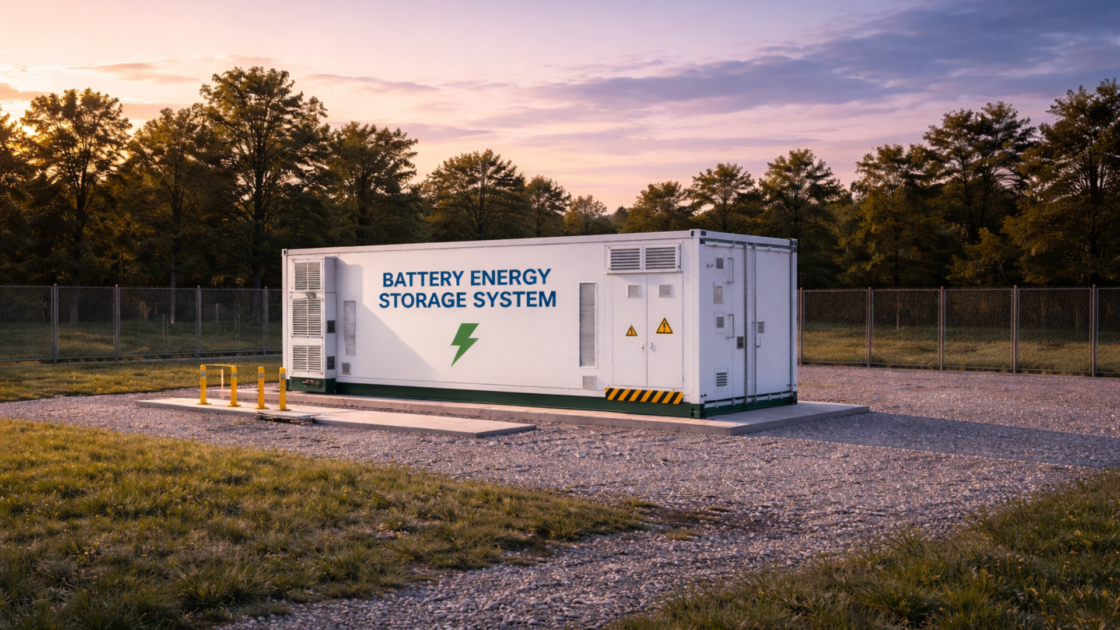
The featured photograph is for representation only.