
NITI Aayog: $14.23 trillion power investment and 5.92 million hectares needed for net zero
Author: PPD Team Date: February 22, 2026

India will require cumulative power sector investment of $14.23 trillion (approximately Rs 1,200 lakh crore) and up to 5.92 million hectares of land by 2070 to achieve net-zero emissions, according to reports released by NITI Aayog. The studies project a sharp rise in electricity demand, large-scale renewable expansion, and significant social, land, water, and workforce impacts as India pursues its net-zero pathway.
Demand growth driven by rapid electrification
The report titled “Scenarios Towards Viksit Bharat and Net Zero: Sectoral Insights – Power (Vol. 7),” developed through an inter-ministerial working group chaired by former Power Secretary Alok Kumar, projects electricity’s share in final energy consumption rising from 21% in 2025 to nearly 60% by 2070 under the net-zero scenario.
Total electricity consumption is expected to reach 12,997 terawatt-hours by 2070 under the net-zero pathway, more than eight times the 2024 level, implying a compound annual growth rate of 4.8%. Under the current policy scenario, consumption is projected at 9,718 TWh by 2070.
Per-capita electricity consumption is projected to increase from 1,400 kWh in 2025 to 10,000 kWh by 2070, approaching levels seen in France and South Korea.
Large capacity expansion centred on renewables
Total installed capacity is projected to expand to 6,800–7,350 GW by 2070 under the net-zero scenario, roughly 14 times present levels. Variable renewable energy, mainly solar and wind, will dominate the mix, with solar PV alone projected at 4,900–5,650 GW.
Energy storage is expected to become a critical enabler of high renewable penetration. Battery energy storage systems could reach 2,500–3,000 GW by 2070, while pumped hydro storage is projected at 150–165 GW.
Nuclear power is identified as a firm clean energy source, with capacity projected at 295–320 GW by 2070, aligned with the government’s Nuclear Energy Mission target of 100 GW by 2047 announced in the Union Budget 2025-26.
Coal’s role shifts during transition
Coal is expected to remain important in the near to medium term for reliability and demand growth. Under the net-zero pathway, coal capacity is projected to peak at 420–435 GW by 2045 before declining to 145–160 GW by 2070, potentially operating mainly as reserve capacity with limited generation.
Investment requirements and infrastructure scale
Cumulative investment requirements between 2025 and 2070 are estimated at $8.79 trillion under the current policy scenario and $14.23 trillion under the net-zero scenario. Of the net-zero total, around 74% is allocated to generation and storage capacity expansion, while 26% is required for transmission and distribution infrastructure.
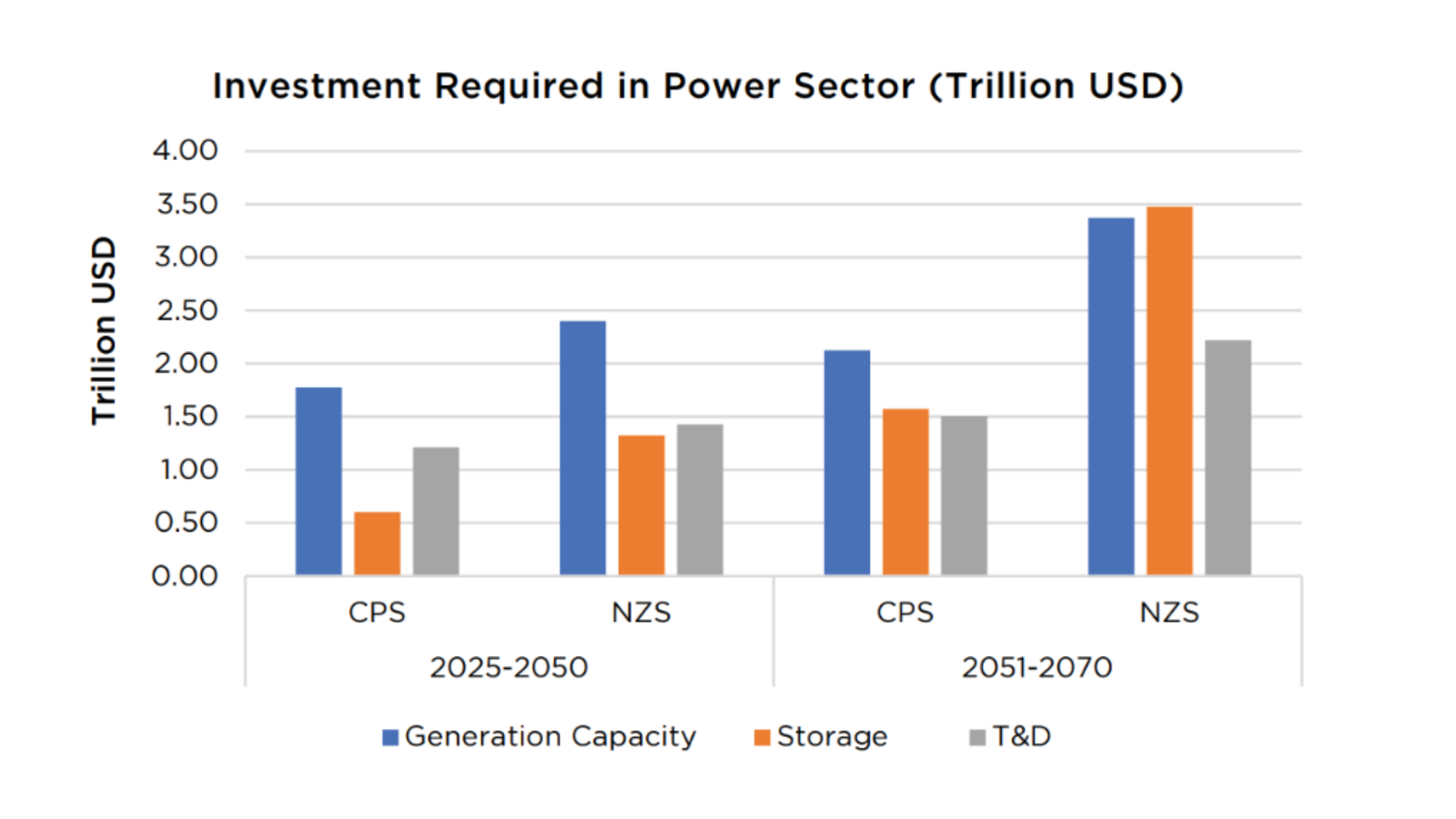
Projected investment requirements in the power sector across generation capacity, storage, and transmission and distribution under the Current Policy Scenario (CPS) and Net Zero Scenario (NZS) for 2025–2050 and 2051–2070. Source: NITI Aayog, Scenarios Towards Viksit Bharat and Net Zero: Sectoral Insights – Power.
The analysis indicates that power sector decarbonisation acts as a central driver of economy-wide emissions reduction by enabling electrification across transport, industry, and other sectors while reducing fossil fuel imports.
Land requirements and resource implications
A separate report titled “Scenarios Towards Viksit Bharat and Net Zero: Social Implications of Transition” estimates land requirements for power sector and green hydrogen infrastructure at 4.2–5.92 million hectares by 2070.
Under the Current Policy Scenario, land demand is projected to reach 4.2 million hectares by 2070, about 7.5% of India’s estimated 56 million hectares of wasteland. Under the Net Zero Scenario, land demand rises to 5.92 million hectares, equivalent to about 11% of wasteland.
Solar, wind, and nuclear deployment account for most of the increase. The report notes that areas classified as wasteland often support grazing, fuelwood collection, and rural livelihoods, requiring careful planning when allocating land for renewable projects.
Water demand trajectory
Water consumption in the power sector is projected to increase from 6.46 billion cubic meters annually in 2030 to 9.90 billion cubic meters by 2070 under the net-zero pathway, driven by higher nuclear deployment and green hydrogen production even as renewable expansion reduces water intensity.
Across scenarios, water use rises through 2050 compared to 2030 levels and then declines by 2070 due to technological improvements and efficiency gains.
Geographic mismatch and regional effects
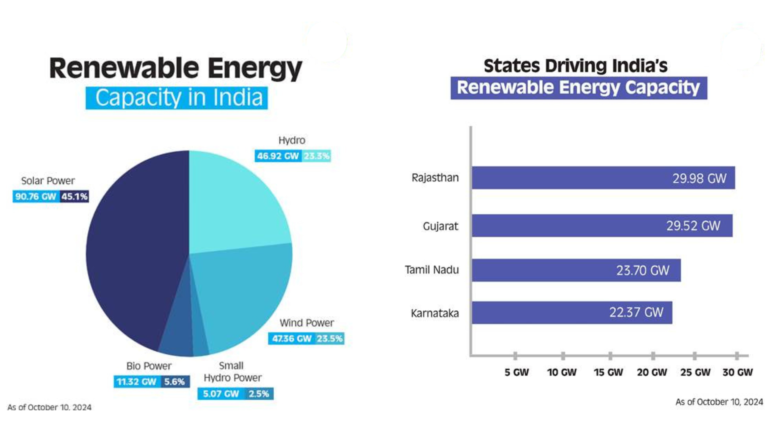
The social implications analysis identifies a geographic mismatch between fossil-fuel-dependent regions and renewable deployment zones. Jharkhand, Chhattisgarh, and Odisha remain dependent on mining and thermal power, while about 75% of solar and wind capacity is concentrated in Rajasthan, Gujarat, Maharashtra, Tamil Nadu, and Karnataka.
Renewable expansion is largely occurring in arid and semi-arid regions that are water stressed, with 56% of solar installations located in water-stressed areas. This creates competition for land and water among agriculture, infrastructure, and local livelihoods.
Employment and workforce transition
More than 150 districts depend significantly on fossil-fuel supply chains, supporting livelihoods for nearly one-third of India’s population. Coal mining employs about 345,000 formal workers, with informal workers at least twice that number. Coal-based thermal plants support about 420,000 jobs nationwide.
When fossil-fuel-linked manufacturing sectors are included, the workforce affected exceeds 16.9 million workers, with more than half in the informal sector.
Under the Net Zero Scenario, energy sector employment is projected to reach around 7 million by 2050, about 1 million higher than under current policies, reflecting expansion in renewable infrastructure and clean technology manufacturing. Construction could add around 4.6 million additional jobs by 2050, while trade could generate 5.2 million cumulative jobs between 2030 and 2070.
Health risks and co-benefits
The report highlights that over 40% of India’s districts face high or very high climate risk. Heatwaves caused more than 24,000 deaths between 1992 and 2015, while air pollution contributed to 1.67 million deaths in 2019, nearly 18% of total deaths.
Urban heat island effects are increasing risks, with cities such as Mumbai, Bengaluru, Bhopal, Jaipur, and Delhi reporting more very warm nights compared with a decade ago. Transition to cleaner energy is expected to deliver health benefits including improved air quality and reduced respiratory and cardiovascular disease.
Grid emissions decline
The grid emission factor is projected to decline from about 0.71 kgCO₂/kWh in 2025 to 0.257 kgCO₂/kWh by 2050 and approach near zero by 2070 under the net-zero pathway, enabling deeper decarbonisation across electrified sectors.
Policy recommendations
Across generation, networks, and markets, the reports recommend scaling solar-wind-storage hybrid projects as standard utility products, expanding green energy corridors, strengthening distribution system operator functions, and deepening power markets with ancillary services and capacity mechanisms.
Financing recommendations include credit enhancement tools such as sovereign guarantees, revenue securitisation, and enabling virtual power purchase agreements to mobilise private capital and reduce financing costs.
The social transition report recommends decentralised renewable deployment, improved land-use mapping, explicit recognition of energy demand in water allocation policies, worker transition frameworks, climate-ready health infrastructure, behavioural interventions, and strengthened implementation of Mission Lifestyle for Environment.
Study development
The power sector modelling was undertaken by teams from NITI Aayog and the Central Electricity Authority using TIMES and ORDENA models. The work involved representatives from the Central Electricity Authority, Ministry of Power, Ministry of New and Renewable Energy, Department of Atomic Energy, industry experts, and knowledge partners.
The social implications study was prepared by the Green Transition, Energy, Climate, and Environment Division of NITI Aayog under the chairmanship of Dr. V.K. Paul, Member of NITI Aayog, with contributions from knowledge partners including the World Resources Institute, World Health Organisation, Council on Energy, Environment and Water, and iFOREST. Leadership for the broader analysis was provided by NITI Aayog Vice Chairman Suman Bery and CEO B.V.R. Subrahmanyam.