Indigenous 30 kW EV drive system unveiled at IIT Madras
Author: PPD Team Date: March 6, 2026
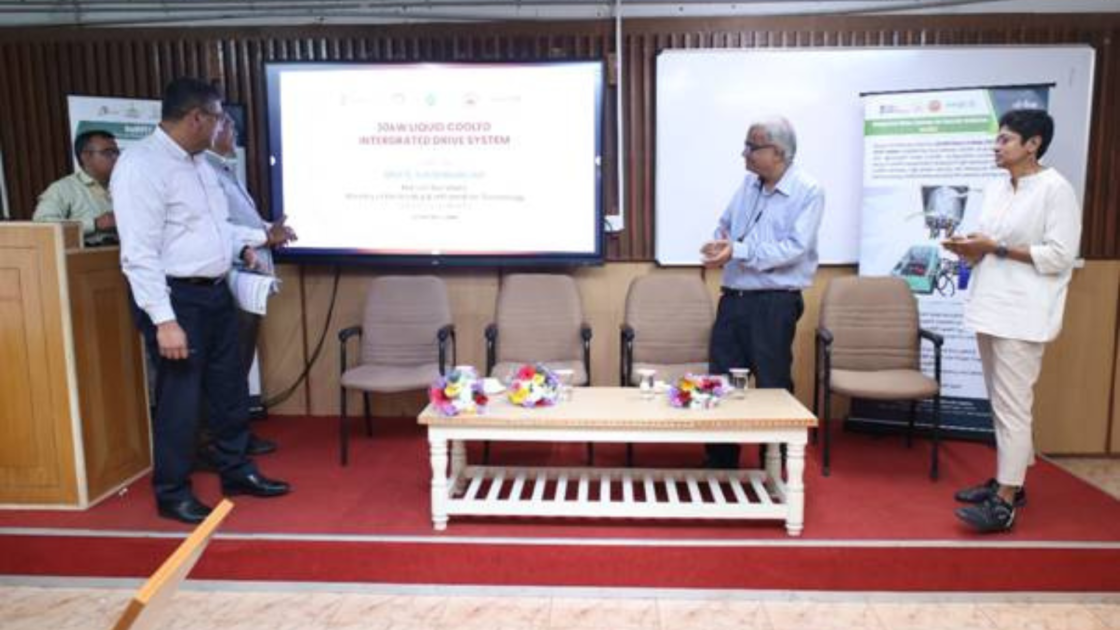
An indigenously developed 30 kW Wide Band Gap (WBG)-based Integrated Drive System (IDS) for electric vehicle applications has been launched in Chennai. The technology was unveiled by S. Krishnan, Secretary of the Ministry of Electronics and Information Technology (MeitY), at the Indian Institute of Technology Madras (IIT Madras).
The system has been developed by the Centre for Development of Advanced Computing (C-DAC), Thiruvananthapuram, in collaboration with IIT Madras and Lucas TVS. The development was carried out under the National Mission on Power Electronics Technology (NaMPET). According to the developers, the system has been designed, fabricated and validated with Lucas TVS and is now ready for commercialisation and wider deployment.
The 30 kW power class is relevant for India’s expanding electric passenger vehicle segment, including compact cars and fleet mobility platforms. A large share of high-performance electric vehicle powertrain systems and semiconductor-based drive components is currently imported. The indigenous system is expected to support localisation, reduce dependence on imports and lower costs through domestic manufacturing, aligned with initiatives such as the Production-Linked Incentive (PLI) schemes.
The integrated drive system combines the electric motor and inverter into a single compact unit with high power density, replacing the conventional configuration where the motor and drive are separate. According to officials, such design-led innovation can support the development of domestic intellectual property, strengthen the start-up ecosystem and expand high-value manufacturing in the electric mobility sector.
Speaking at the launch, Krishnan said the development reflects the vision of “Make in India, Make for the World” promoted by Prime Minister Narendra Modi. He stated that collaboration among research institutions, academia and industry is enabling India to progress from a technology-importing nation toward a technology-developing and exporting economy.
Krishnan described the development as a milestone in India’s efforts to advance self-reliance in electric mobility and strategic electronics.
According to officials, wider adoption of the technology could strengthen India’s electric vehicle supply chain and create opportunities for micro, small and medium enterprises (MSMEs) involved in power electronics manufacturing, thermal management systems and control hardware. Through NaMPET, MeitY continues to promote partnerships aimed at developing globally competitive power electronics technologies for future mobility and energy systems.
Photo credit: PIB