India’s interstate P2P electricity trading pilot tests regulatory readiness
Author: PPD Team Date: March 13, 2026
India’s electricity sector is on the cusp of a carefully constructed experiment. The Ministry of Power’s proposal to pilot peer-to-peer (P2P) electricity trading under the India Energy Stack (IES) has drawn widespread attention, frequently compared to UPI’s transformation of digital payments and Aadhaar’s reimagining of identity infrastructure. The analogy is evocative. But for regulators and practitioners, the more important question is not whether P2P trading can work in theory, but whether India’s existing regulatory architecture can absorb it in practice.
The answer, as landmark orders from Delhi and Uttar Pradesh now make clear, is cautiously yes: but only within tightly defined boundaries, and only after significant institutional coordination.
What P2P Electricity Trading Actually Means
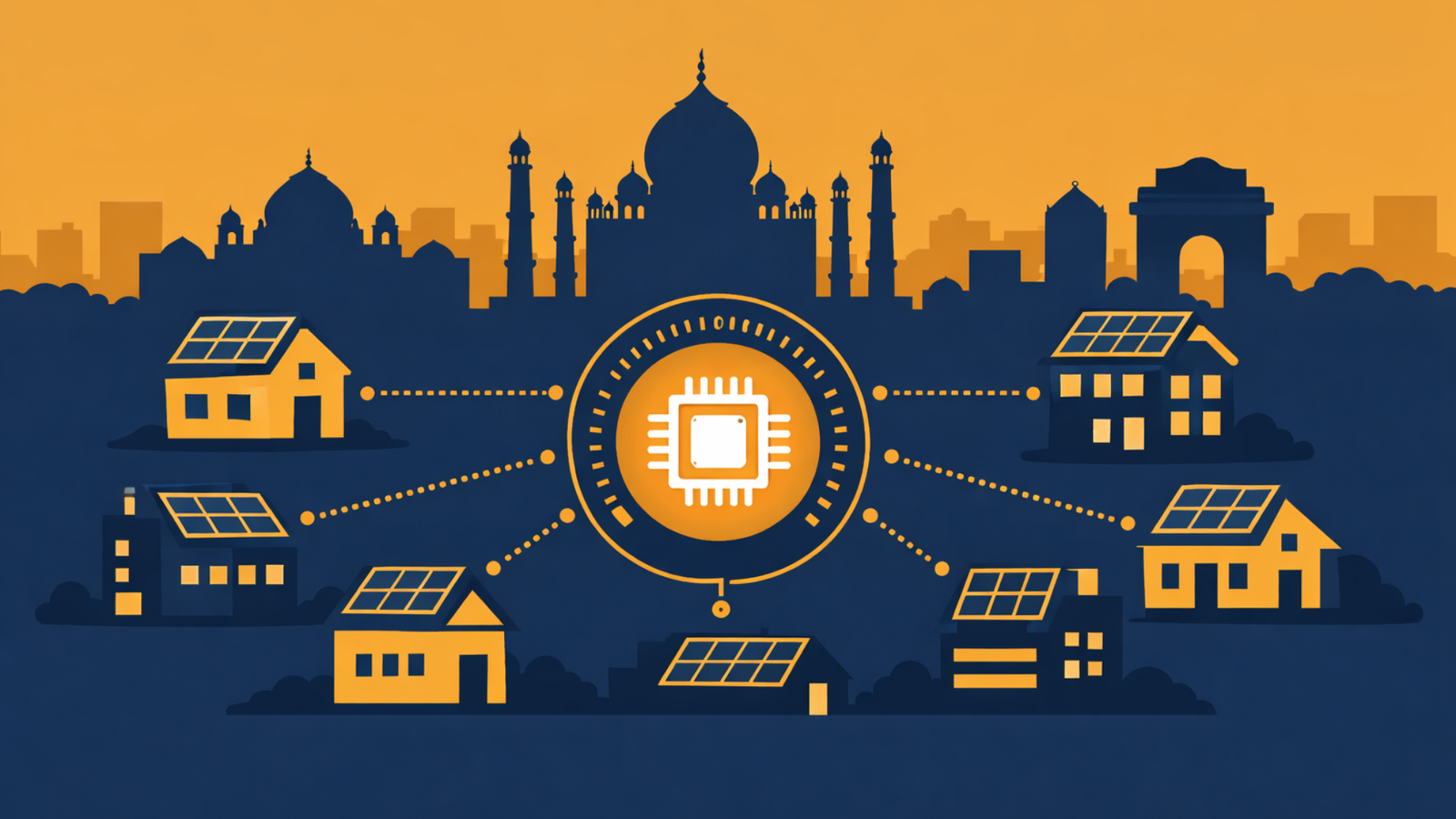
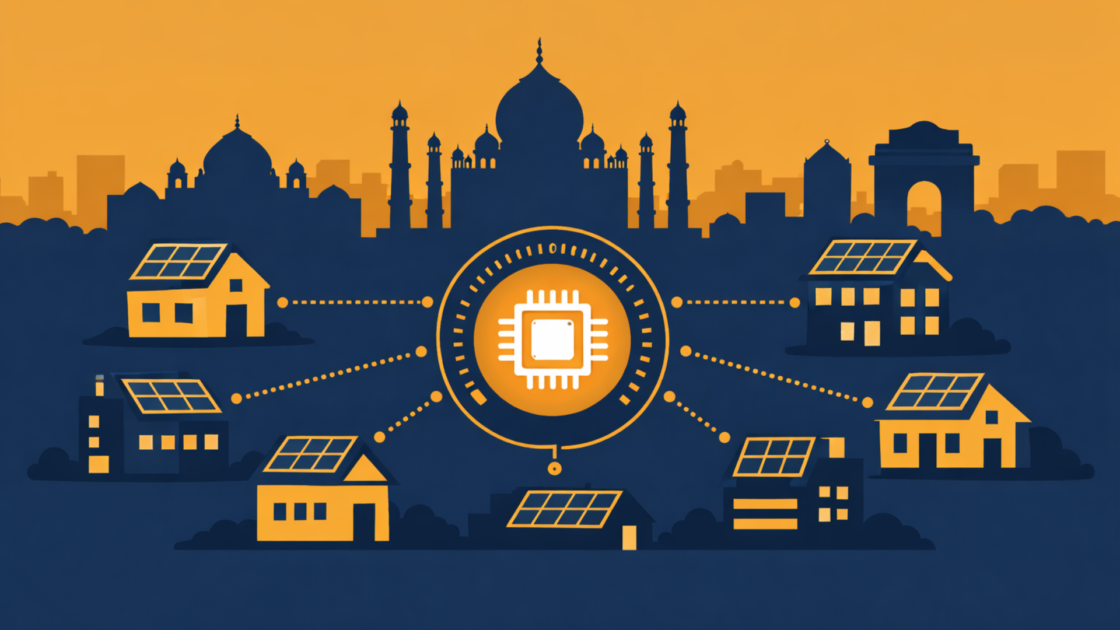
At its core, P2P electricity trading allows a consumer who also generates electricity (typically through rooftop solar) to sell surplus power directly to another consumer, rather than feeding it back under conventional net-metering. The seller becomes a “prosumer.” The buyer is typically a neighbouring household or commercial establishment on the same platform.
Transactions happen through a digital marketplace: prosumers and consumers publish bids and offers, conclude day-ahead contracts, and settle through secure payment systems. Energy flows are reconciled using smart meter data, often verified through blockchain-based mechanisms. REC Limited has been designated as the nodal agency for the IES framework, which provides the foundational digital infrastructure on which these transactions are built.
What makes this distinct from conventional renewable procurement is its granularity. Rather than a utility purchasing bulk power under a long-term PPA, individual consumers transact in real time, at distribution voltage levels, in small quantities, using digital wallets. It is market-enabled energy access at the retail level, something India’s power sector has not previously attempted at scale.
What Regulators Actually Approved
The clearest picture of where this initiative stands comes from two regulatory orders issued in early 2026: one by the Delhi Electricity Regulatory Commission (DERC) on February 11, and the other by the Uttar Pradesh Electricity Regulatory Commission (UPERC) on February 26.
DERC approved pilot proposals filed by Tata Power Delhi Distribution Limited (TPDDL) and BSES Rajdhani Power Limited (BRPL), permitting P2P transactions across different distribution companies within Delhi and, crucially, across the state boundary into Uttar Pradesh. UPERC simultaneously approved a petition by Pashchimanchal Vidyut Vitran Nigam Limited (PVVNL), permitting interstate P2P transactions between its licensed territory in western Uttar Pradesh and consumers served by TPDDL and BRPL in Delhi.
Together, these constitute India’s first formally approved interstate P2P electricity trading framework, connecting prosumers and consumers across service territories of distribution licensees in two different states under two different regulatory jurisdictions. The regulatory coordination required to produce parallel, mutually consistent orders is itself a notable institutional achievement.
The design choices embedded in the approvals are instructive. Transaction charges were set at Rs 0.42 per kWh, shared equally between prosumer and consumer. DERC rejected additional wheeling charges within Delhi, reasoning they are already recovered through retail tariffs, though UPERC maintained that cross-boundary charges to Uttar Pradesh would apply. The previous cap limiting P2P trades to 20% of installed solar capacity was removed, significantly improving commercial attractiveness for rooftop solar owners. Deviation penalties were waived for the six-month pilot period, with the commissions acknowledging that such penalties (appropriate for mature markets) could deter participation at this early stage.
Smart meters are mandatory for all participants. Both commissions were unequivocal on this point, and UPERC’s December 2025 amendment mandating this requirement regardless of payment mode was an important clarification.
The Structural Constraints That Define the Limits
Understanding the full picture requires appreciating what these pilots are operating within. India’s electricity market is not a liberalised retail market. State distribution companies hold monopoly responsibility for retail supply, universal service obligations, and network cost recovery. This architecture shapes what P2P trading can and cannot do.
The most consequential constraint is cross-subsidy. India’s retail electricity pricing relies heavily on cross-subsidisation: industrial and commercial consumers effectively subsidise agricultural users and low-income households. If higher-paying consumers migrate to P2P transactions without robust mechanisms to recover network and cross-subsidy contributions, the financial architecture of the distribution sector is weakened. UPERC’s decision to waive the cross-subsidy surcharge for the pilot is commercially significant, but carries systemic sensitivity at any larger scale.
DISCOM finances compound this concern. Many utilities remain financially stressed. P2P transactions continue to rely on the same grid infrastructure: poles, wires, transformers, load dispatch systems. If fixed costs are not transparently recovered, prosumer benefits risk being privatised while network costs remain socialised across the non-participating consumer base.
The pilot’s tight scope (rooftop solar prosumers at distribution voltage, small-scale injections, within the service territories of TPDDL, BRPL, and PVVNL) is not timidity. It is a deliberate design choice to protect financial and operational integrity while testing digital infrastructure.
The Smart Meter Gap and Market Economics
No discussion of P2P trading in India is complete without confronting metering reality. Smart metering under the Revamped Distribution Sector Scheme has made progress but remains uneven. Without granular, verifiable data, settlement disputes are inevitable, consumer confidence is undermined, and cross-subsidy accounting becomes unstable.
The market economics also impose their own limits. Most residential solar systems generate modest surpluses, typically during mid-day hours when household consumption is lower, creating thin, time-constrained local markets. After accounting for transaction and wheeling charges, the incremental gain for a prosumer over existing net-metering arrangements may be marginal in many cases. The pilot’s commercial significance lies less in trade volumes and more in institutional learning: testing matching algorithms, settlement workflows, and consumer behaviour in a live but controlled environment.
The Strategic Value: Learning, Not Disruption
It would be a mistake to underestimate the strategic significance of what has been set in motion. This pilot establishes, for the first time, a multi-state, multi-utility digital trading framework for retail electricity. It tests whether regulatory coordination between different SERCs (historically siloed) can produce interoperable rules requiring real-time settlement. It builds familiarity with decentralised transactions among utilities long accustomed to operating as vertically integrated monopolies. And it creates a practical foundation for deeper reforms: cost-reflective tariffs, rationalised cross-subsidies, DISCOM restructuring, and harmonised regulatory frameworks.
The scalability of the model will ultimately depend on regulatory clarity around settlement, consumer protection, data governance, and dispute resolution, areas where this six-month pilot will generate invaluable real-world data.
Calibrated Optimism
The interstate P2P pilot is a landmark regulatory development. It demonstrates that Indian electricity regulators can move with purpose and coordination when presented with a well-scoped, technically credible proposal. But the broader lesson is one of structured realism: P2P trading in India is not a market disruption. It is a carefully managed experiment in digital infrastructure for a regulated system.
Digital platforms can enable secure, low-cost transactions between prosumers and consumers across distribution boundaries. They cannot substitute for the structural policy reforms on which meaningful retail market development ultimately depends.
For now, P2P electricity trading is best understood as a high-value experiment, one whose outcomes will shape whether India’s power sector can one day transition from a regulated, utility-centric model to a genuinely consumer-centric one.