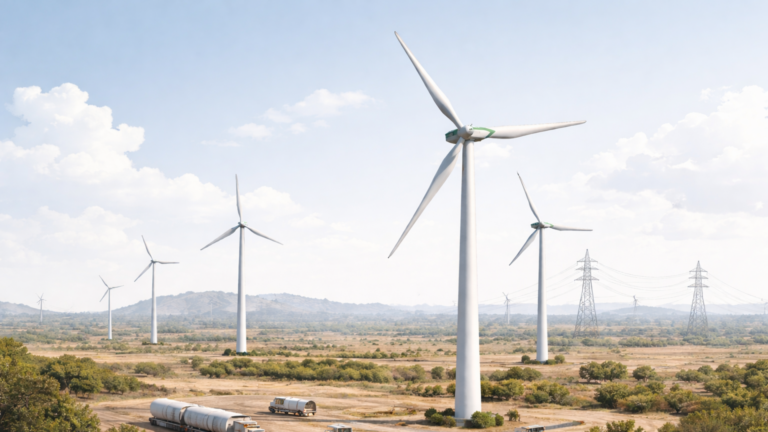

From Turbines to Transmission: Integrating Wind into India’s Future Grid
By Consolidated Energy Consultants Limited (CECL)

India’s energy transition entered a defining moment in January 2026 with a series of central and state actions designed to embed variable renewable energy, particularly wind, deeper into grid operations and long-term capacity planning. These initiatives reflect a clear evolution: from simply adding capacity to fundamentally re-engineering how the grid thinks about dispatchability, frequency management, and multi-modal evacuation.
Key Central Initiatives: Making Wind and Solar Grid-Responsive
At the heart of the Centre’s latest proposals is the extension of Automatic Generation Control (AGC) to large-scale wind and solar projects (specifically those over 100 MW) including battery storage and pumped hydro plants. AGC has traditionally been a mainstay of thermal and hydropower operations for primary and secondary frequency control; its move into variable renewables signals a strategic shift. AGC enables real-time adjustments to generation output based on grid frequency deviations, which dramatically improves how wind and solar interact with system requirements rather than acting as passive “must-take” resources.
Building on operational learnings from Rajasthan pilots, where AGC effectively balanced solar ramps and reduced frequency excursions, this policy recognizes that renewables can be grid assets (not liabilities) when equipped with the right control interfaces. For wind developers, this means integrating advanced SCADA, MPPT signaling, and telemetry capable of sub-minute dispatch changes. In future rounds, AGC compliance may tie directly to incentives (up to ₹0.5/kWh) or curtailment compensation at full PPA rates, making curtailment economics more predictable and manageable.
On the transmission front, Powergrid’s recent win to build a 400 kV evacuation line in Karnataka is a cornerstone capability investment. Designed to evacuate up to 3 GW of renewables from wind-rich belts such as Davanagere and Bellary through a regulated ISTS framework, this project demonstrates Washington-style grid planning adapted to India’s unique geographic resource diversity. It also underscores the shift toward proactive transmission planning rather than reactive mitigation of bottlenecks that plagued Rajasthan’s wind output in the previous season.
In offshore wind, central approvals now back Gujarat’s ~Rs 6.9 billion transmission system to evacuate 500 MW by 2029, with the Central Transmission Utility (CTU) managing subsea cables and junction substations. This centrally managed approach de-risks investor capital by decoupling complex offshore build-outs from IPP balance sheets, while maintaining developers’ control over feeder connections.
State and Regional Shifts: Local Strategies for a National Goal
States are not only aligning with national frameworks, rather they are innovating at the edges.
Rajasthan developers, in early 2026 consultations, have pressed for reserved wind zones such as Fatehgarh and Ramgarh. Their rationale is simple and powerful: wind complements solar’s diurnal profile, reducing the need for costly storage by exploiting a natural 2:1 solar-to-wind generation mix across a 24-hour cycle. These wind zones are being positioned not as ancillary to solar parks but as operational anchors that absorb evening ramp-downs and flatten net load curves.
In Tamil Nadu, readiness for offshore tenders by February 2026 is progressing on schedule. Post-assessment studies have affirmed the state’s coastal resource potential, spatial constraints, and grid interface feasibility, aligning closely with Gujarat’s strategy under MNRE’s split evacuation model. Under this hybrid model, developers handle internal park infrastructure up to the substation, while CTU constructs export lines to pooling stations, unclogging one of the classic bottlenecks in India’s renewable rollout narrative.
Policy signalling is also emerging in procurement practices: a July 2025 mandate now requires wind turbine makers to localize supply chains and maintain data centers domestically, with cyber controls and ICS/OT security baked into grid interfacing. The intent is twofold: enhancing domestic manufacturing utilization to 70–80 % and protecting critical systems against cyber threats as wind plants evolve into dispatchable entities.
What This Means for Wind Developers
Together, these central and regional moves have significant commercial and technical implications:
- Grid Responsiveness Is Mandatory: Integration of AGC, MPPT signaling, and real-time telemetry is no longer a nice-to-have. Developers unable to provide dispatch quality generation may see higher curtailments without compensation—or miss out on incentive streams tied to grid services.
- Evacuation Risks Are Diminishing: Dedicated corridors and waived ISTS charges (extended into mid-2025) materially reduce early-stage cost burdens, especially in zones where congestion has historically dampened wind utilisation. These provisions improve bankability and shorten positive cashflow horizons.
- Local R&D and Manufacturing Matter: The localization mandate pushes OEMs and EPCs toward Indian supply chains and laboratory ecosystems. This aligns with Make-in-India aspirations while expanding the domestic technology base for advanced turbine controls and storage interfaces.
- Hybrid Project Economics Improve: With storage now AGC-enabled and part of central grid planning, hybrid bids that strategically combine wind with BESS or pumped hydro gain a competitive edge—offering both capacity firming and ancillary revenue participation.
Future Trajectory: From Variability to Reliability
The roadmap ahead points to a transmission and operational architecture fit for high-renewable penetration:
- Offshore and Hybrid Tenders Will Surge: With CTU assuming key subsea roles and states preparing coastal offers, offshorehybrid procurement could scale rapidlypotentially hitting multi-GW tranches between 2027 and 2030.
- HVDC Hubs and Regional Links Matter: As interstate links grow and HVDC hubs emerge to tie distant resource pockets (e.g., Gujarat offshore, Tamil Nadu coast, Karnataka inland), transmission planning may pivot toward interconnected renewable super-corridorssimilar to Europe’s TYNDP model.
- AGC Standardization Unlocks Storage Value-Stacking: With standardized AGC frameworks across wind, solar, BESS and pumped hydro, market participants can pursue ancillary services stacking, optimizing revenues beyond pure energy sales.
- Wind Anchors Baseline Reliability: By 2030, a picture emerges of grids where wind (historically seen as variable) becomes a reliability anchor, with system operators able to dispatch, curtail, and soak up variability in real time.
Conclusion: Execution Is the New Frontier
India’s renewable story has long focused on scale. The next chapter is about integration, reliability, and economic optimization. From AGC mandates to offshore evacuation build-outs, from state reserve zones to manufacturing localization, the policy ecosystem is maturing. For wind developers, transmission planners, and investors alike, the message is clear: adaptability and grid-readiness are the new competitive differentiators.
If execution matches the ambition laid out today, India will not just meet its capacity targets, it will redefine how high-renewable grids operate in emerging markets. That’s a narrative global capital is watching closely.
The featured photograph is for representation only.