Scaling India’s Nuclear Fleet: Projects, Policy, and Challenges
Author: PPD Team Date: August 12, 2025

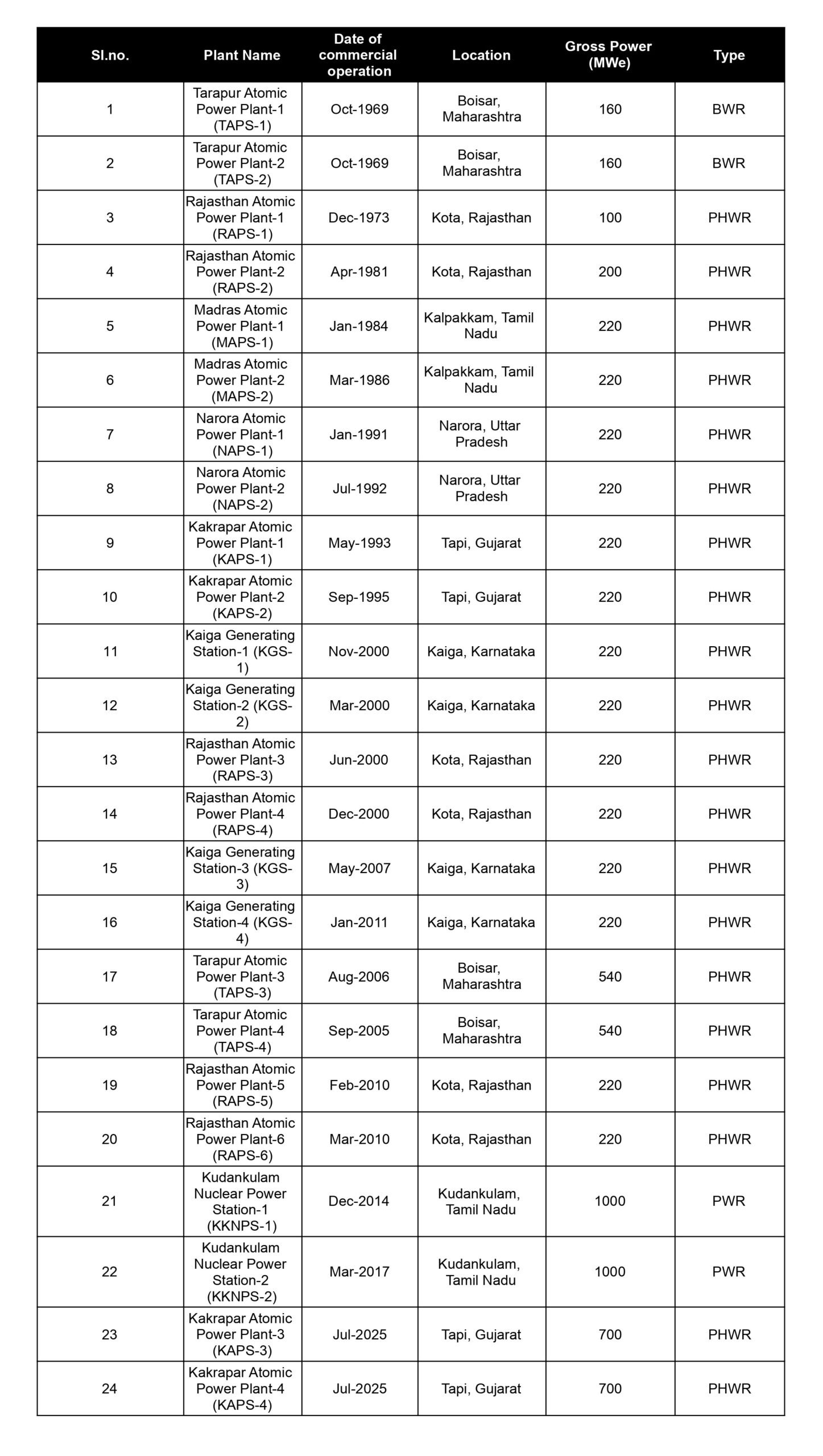
As of 2025, India operates 24 commercial reactors with a combined installed capacity of 8,780 MW. This figure excludes RAPS-1 (100 MW), which remains under long-term shutdown. These reactors generated about 56.7 billion units (BU) of electricity during the financial year 2024-25, constituting roughly 3.1% of the nation’s total power generation of 1,830 BU. Recent parliamentary updates and policy moves show a clear push to scale capacity and deepen fuel-cycle capabilities.
At the forefront of India’s nuclear landscape stands the Kudankulam Nuclear Power Plant (KKNPP) in Tamil Nadu, currently the country’s largest nuclear power station. KKNPP operates two VVER-1000 reactors, providing 2,000 MW of electricity. Its ongoing expansion includes four additional reactors, Units 3, 4, 5, and 6, each designed to contribute a further 1,000 MW. Upon their completion, Kudankulam’s total capacity will reach 6,000 MW, making it a significant energy hub not only for Tamil Nadu but for the southern grid as a whole.
Complementing Kudankulam’s expansion is the Prototype Fast Breeder Reactor (PFBR) at Kalpakkam, Tamil Nadu, developed by Bharatiya Nabhikiya Vidyut Nigam Limited (BHAVINI). This 500 MW sodium-cooled fast breeder reactor is a critical milestone for India’s nuclear power program.
Eighteen reactors totalling 13,600 MW, including the 500 MW PFBR being implemented by BHAVINI, are at various stages of implementation. On progressive completion, installed nuclear capacity will rise from 8,780 MW to about 22,380 MW.
List of nuclear power plants under operation in India:
India follows a closed nuclear fuel cycle aligned with its three-stage nuclear program to maximize fuel use. It recycles fissile and fertile materials from spent nuclear fuel rather than disposing of it. Domestic uranium fuels PHWRs, while plutonium from reprocessed spent fuel powers fast breeder reactors. Large-scale thorium use will follow, breeding Uranium-233 from Thorium-232.
Bhabha Atomic Research Centre (BARC) leads thorium research and has demonstrated thorium use in test reactors. Small-scale uses such as the KAMINI (Kalpakkam Mini) reactor show feasibility, while larger thorium deployment remains a future objective.
Atomic Minerals Directorate for Exploration and Research (AMD) has identified significant uranium and thorium resources across multiple states, supporting long-term fuel security. Uranium Corporation of India Limited (UCIL) manages mining and processing, while AMD leads exploration. Offshore atomic mineral rules limit operating rights to government entities, so uranium operations remain under the Department of Atomic Energy (DAE).
India has unveiled the Nuclear Energy Mission to achieve 100 gigawatts (GW) of nuclear capacity by 2047, which coincides with the centenary of India’s independence. Announced in the Union Budget 2025–26, the mission received ₹20,000 crore in funding. It aims to expand nuclear capacity and establish at least one nuclear power plant in every state. To meet the target, India needs to sustain annual capacity additions exceeding 4 GW, requiring faster project execution, technology diversification, and strategic investment.
The Nuclear Energy Mission prioritises indigenous technologies and advanced reactor designs. BARC is developing three demonstration reactors: a 200 MWe Bharat small modular reactor, a 55 MWe small modular reactor, and a 5 MWth high-temperature gas-cooled reactor for hydrogen production. These reactors are indigenously designed for repurposing retiring fossil fuel plants, captive use in energy-intensive industries, and off-grid applications in remote areas.
Conceptual and detailed designs are at advanced stages. Prototype demonstration reactors will establish technology readiness for design, construction, and operation. Lead units of the SMR-55 and BSMR-200 MWe are planned at DAE sites for demonstration, expected to be constructed within 60 to 72 months after project sanction.
Safety is the highest priority across siting, design, construction, commissioning and operation. Plants are designed following defence-in-depth principles, redundancy, diversity and fail-safe features to maintain multiple barriers between radioactivity and the environment. Operations are carried out by trained, licensed personnel under strict procedures. An independent regulator, the Atomic Energy Regulatory Board, continuously monitors safety. International peer review and audits inform standards and improvements.
Nuclear provides stable, low-carbon baseload power that supports the integration of wind and solar. It can reduce fossil-fuel imports and emissions while enhancing energy security. Faster nuclear expansion will support India’s climate commitments. Despite the promising outlook, several challenges remain, particularly regarding the private sector and foreign participation. The Atomic Energy Act of 1962 currently reserves nuclear power generation rights exclusively for the government, limiting private investments. Further, the Civil Liability for Nuclear Damage Act of 2010, which imposes supplier liability, has been cited as a deterrent for foreign capital inflows. Recognising these barriers, the government is actively considering amendments to these pieces of legislation to unlock private and foreign investments, accelerate technology infusion, and foster greater competition within the sector.
In conclusion, India’s nuclear energy pathway, anchored in robust policy frameworks and supported by detailed project portfolios, symbolises a critical trajectory toward a sustainable and energy-secure future. The integration of large-scale and modular reactor technologies, expansion of fuel resources, strategic state-wise plant deployment, and strengthened safety governance together form a comprehensive roadmap to achieving 100 GW of nuclear capacity by 2047. As this vision materialises, nuclear energy will not merely complement India’s electricity supply but become a durable foundation for economic growth, technological innovation, and climate resilience, positioning India among the world’s leading nuclear energy nations by mid-century.
The featured photograph is for representation only.