Regulatory Developments in Renewable Sector: May 7, 2025
Author: PPD Team Date: May 7, 2025

APERC approves 400 MW wind-solar hybrid projects
The Andhra Pradesh Electricity Regulatory Commission (APERC) has granted approval for four amended Power Purchase Agreements (PPAs) totaling 400 MW of wind-solar hybrid power. The projects, developed by Axis Energy Ventures India Private Limited (AEVIPL) under the Bundling, Balancing, and Banking (BBB) scheme, will supply electricity to the Southern Power Distribution Company of Andhra Pradesh (APSPDCL) at a fixed tariff of Rs 4.60 per kWh for 25 years.
Objections raised during the approval process included concerns over the procurement route, tariff justification, and grid stability. Critics argued that competitive bidding should have been used instead of MoU-based PPAs, citing higher costs compared to market rates. However, APERC upheld the agreements, noting their alignment with state policies, a high Capacity Utilisation Factor (CUF) of 60%, and provisions for energy storage to ensure peak-hour power supply. The projects are also key to meeting the state’s Renewable Purchase Obligation (RPO) targets, which will increase to 43.33% by 2030.
The commission’s final order requires AEVIPL to install energy storage systems to guarantee 90% power availability during peak hours (5–9 AM and 7–11 PM), with penalties for any shortfalls. APERC dismissed objections about outdated policies, stressing the state’s commitment to honouring prior agreements. The approved tariff is lower than recent tariffs discovered through FDRE bidding, such as those by SECI (Rs 4.64–4.72/kWh), and avoids Inter-State Transmission System (ISTS) charges by using state grid infrastructure.
Petition No. O.P.No.91 of 2024 | Read the full order here.
APTEL dismisses AMP Energy’s appeal against WBERC’s PPA approval
The Appellate Tribunal for Electricity (APTEL) dismissed an application seeking condonation of a 374-day delay in filing an appeal against the West Bengal Electricity Regulatory Commission (WBERC)’s order approving a power purchase agreement (PPA) and adopting a tariff for a 150 MW wind-solar hybrid project. The case involved AMP Energy Green Seventeen Private Limited, which challenged WBERC’s jurisdiction over the PPA and tariff of Rs 2.92/kWh for power supplied to CESC Limited.
AMP Energy argued that WBERC lacked jurisdiction, as the project involved inter-state power supply and should fall under the Central Electricity Regulatory Commission (CERC). The delay was due to the company’s delayed recognition of this jurisdictional issue, after facing execution delays caused by force majeure events, including land allocation cancellations by the Andhra Pradesh government.
The Tribunal ruled that the delay was inordinate and unjustified, emphasizing that ignorance of law does not justify the delay. It noted AMP Energy had actively participated in WBERC proceedings and only raised the jurisdictional issue after CESC denied its request for an extension of the Scheduled Commercial Operation Date (SCOD). The Tribunal also rejected the plea to treat the appeal as a revision under Section 111(6) of the Electricity Act, stating it would undermine statutory limitation periods.
The plea for condonation was dismissed, and the appeal was rejected. All interim applications were disposed of.
IA No. 1787 OF 2024 IN DFR No. 478 of 2024 & IA No. 491 OF 2025 | Read the full order here.
APERC allows ad-hoc tariff of Rs 2.50/unit for 1.4 MW mini-hydel project
The Andhra Pradesh Electricity Regulatory Commission (APERC), in an interim order dated April 23, 2025, has allowed the Central Power Distribution Company of Andhra Pradesh Ltd (APCPDCL) to procure power at an ad-hoc tariff of Rs 2.50 per unit from M/s Active Power Corporation Private Limited.
The procurement pertains to a 1.4 MW mini-hydel project located on the Budemeru Diversion Canal in NTR District, Andhra Pradesh. APCPDCL had filed the Original Petition seeking approval for the Power Purchase Agreement (PPA) signed on January 6, 2025.
As the final tariff and PPA approval are still pending before the Commission, APCPDCL filed an Interlocutory Application requesting interim approval to procure power at Rs 2.50 per unit or any rate determined by the Commission. The respondent did not object to the proposed ad-hoc tariff. APERC granted the interim relief, allowing procurement at Rs 2.50 per unit, subject to the Commission’s final decision on tariff and PPA approval.
Petition No. IA No.1 of 2025 in OP No.7 of 2025 | Read the full order here.
GERC approves Rs 5.35 per kWh tariff for 35 MW solar PV project with BESS
The Gujarat Electricity Regulatory Commission (GERC) has approved a fixed tariff of Rs 5.35 per kWh for a 35 MW grid-connected solar PV project with a 57 MWh Battery Energy Storage System (BESS) at the Kutch Lignite Thermal Power Station (KLTPS). Developed by Gujarat State Electricity Corporation Limited (GSECL), the project was commissioned in phases on 20 March and 21 April 2024.
GSECL filed the tariff petition under Section 62 of the Electricity Act, 2003, requesting approval for a 25-year levelized tariff. The project, awarded to Larsen & Toubro under an EPC contract valued at Rs 336.87 crores, also includes a 10-year operation and maintenance (O&M) agreement. The financial assumptions for the project include a normative debt-equity ratio of 70:30, a reduced Return on Equity (RoE) of 10.89%, and a discount rate of 7.92%.
The depreciation for the project is set at Rs 302.99 crores over its life, with the solar component depreciating over 25 years and the battery system over 12 years. The interest on loan is calculated at Rs 88.63 crores at an interest rate of 6.65% per annum, despite the project being fully equity-funded. O&M costs are estimated at Rs 63.23 crores, escalating at an annual rate of 3%.
Petition No. 2445 of 2025 | Read the full order here.
APTEL reinstates AERC’s tariff order for Suryataap Energies
The Appellate Tribunal for Electricity (APTEL) has allowed a review petition from Suryataap Energies and Infrastructure Private Limited, overturning its earlier decision from December 19, 2024. The tribunal reaffirmed the Assam Electricity Regulatory Commission’s (AERC) tariff order, dated November 29, 2017, and acknowledged a “patent and glaring mistake” in its previous judgment, which had sent the case back to AERC for a new tariff determination.
The dispute involved the tariff for Suryataap’s 5 MW solar PV project in Assam, commissioned in August 2016. AERC set the tariff at Rs. 8.78 per kWh for 25 years. APDCL contested this, claiming AERC used incorrect CERC norms for the 2015-16 financial year. The tribunal had initially agreed, directing AERC to reassess the tariff based on the correct year’s benchmarks.
Upon review, the tribunal clarified that AERC had not blindly adopted CERC norms but referenced them while accounting for Assam-specific factors like higher transportation and labor costs. It found AERC had independently determined most cost components.
The April 2025 ruling reinstates AERC’s original tariff and dismisses APDCL’s appeal, confirming AERC’s compliance with the Electricity Act, 2003, and ensuring fair stakeholder consideration.
RP No. 3 of 2025 IN APPEAL No. 378 of 2018 | Read the full order here.
CSERC allows Mahavir Wires to draw solar power via non-dedicated feeder
The Chhattisgarh State Electricity Regulatory Commission (CSERC) has granted exemption to M/s Shri Mahavir Wires Pvt. Ltd. from the requirement of having a dedicated feeder for availing long-term open access for solar power at the user end.
The petitioner had installed a 1.4 MW (AC) solar PV plant at Bhalukona, Rajnandgaon, for captive use. It sought permission to draw this power at its manufacturing unit in Bhilai through a common distribution feeder, citing low drawl and infeasibility of a dedicated feeder.
Both distribution and transmission licensees—CSPDCL and CSPTCL—did not object, provided the petitioner fulfilled certain technical and operational conditions, including installation of ABT (Availability Based Tariff) meters with AMR (Automated Meter Reading), RTU (Remote Terminal Unit) for data communication, and an undertaking waiving claims during feeder outages.
CSERC accepted the petitioner’s undertaking and allowed open access through the multi-consumer Niroj feeder, as permitted under clause 5(5) of the CSERC Open Access Regulations, 2011, and its amendments.
Petition No. 18 of 2025 | Read the full order here.
KSERC approves Rs 5.18 crore investment by Technopark for power upgrades and solar plants
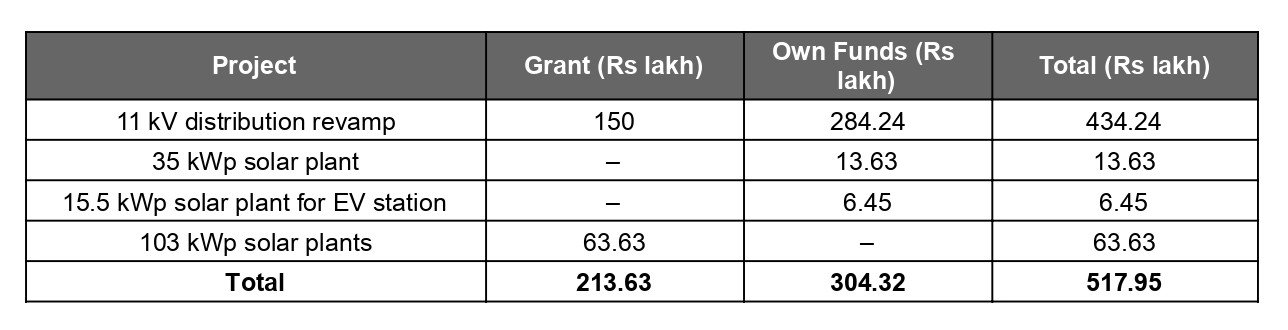
The Kerala State Electricity Regulatory Commission (KSERC) has provisionally approved a Rs 5.18 crore capital investment plan by Technopark, Trivandrum. The order, issued on 23 April 2025, covers system upgrades and solar installations aimed at improving reliability and meeting statutory power supply norms.
The largest allocation, Rs 4.34 crore, is for revamping the 11 kV distribution network in Technopark Phase I. This includes replacing old cables, adding feeders, and installing Ring Main Units (RMUs) with SCADA monitoring. The upgrade will help meet the “n-1” contingency standard. Funding includes a 35% government grant (Rs 1.50 crore) and 65% from Technopark’s internal funds.
KSERC also approved three solar projects: a 35 kWp rooftop system (Rs 13.63 lakh), a 15.5 kWp plant for an EV charging station (Rs 6.45 lakh), and a 103 kWp installation at Park Centre and Pump House (Rs 63.63 lakh). The Commission mandated use of MNRE benchmark rates and existing government grants.
Capital Investment Breakdown:
Petition No: OP 83/2023 | Read the full order here.
MERC affirms jurisdiction in PPA dispute between MSEDCL and Braithwaite Nacof
The Maharashtra Electricity Regulatory Commission (MERC) has settled a jurisdictional dispute between Maharashtra State Electricity Distribution Co. Ltd. (MSEDCL) and Braithwaite Nacof Solar Project Ltd. over a terminated Power Purchase Agreement (PPA) for a 500 MW solar project. The dispute arose after Braithwaite failed to meet the extended Scheduled Commercial Operation Date (SCOD) of 31 March 2024, leading MSEDCL to terminate the PPA.
Braithwaite challenged the termination before the Bombay High Court, invoking the PPA’s arbitration clause. The High Court directed the parties to approach MERC. MERC, in its order under Section 86(1)(f) of the Electricity Act, 2003, confirmed its jurisdiction to adjudicate the matter. It held that Braithwaite qualified as a “deemed generator” despite termination of the PPA, citing the Supreme Court ruling in Gujarat Urja Vikas Nigam Ltd. v. Essar Power Ltd..
MERC allowed the dispute to proceed to arbitration, in line with the High Court’s directions. Both parties had already appointed arbitrators—Retired Justice Sadhana Jadhav (Braithwaite) and Retired Justice Manoj Sanklecha (MSEDCL). The arbitrators will now jointly appoint a presiding arbitrator.
The High Court upheld MERC’s jurisdiction but left the substantive issues for the arbitral tribunal. The Commission noted that Braithwaite’s waiver of specific performance claims did not affect its adjudicatory authority under the Electricity Act.
Petition No. Case No. 52 of 2025 | Read the full order here.
MPERC enforces monthly RPO compliance reporting via new online portal
The Madhya Pradesh Electricity Regulatory Commission (MPERC) has issued a new protocol for monitoring Renewable Purchase Obligation (RPO) compliance, effective from 15 April 2025. The framework amends the 2021 RPO regulations and mandates monthly submissions via a dedicated RPO portal.
Obligated entities, including Open Access Consumers, Conventional Captive Power Plants, MP Power Management Company Limited (MPPMCL), Indian Railways, and Madhya Pradesh Industrial Development Corporation (MPIDC), need to register and submit reports on the RPO portal (https://mperc.in/page/rpo-portal).
The State Load Despatch Centre (SLDC) and the three distribution companies will serve as the RPO Monitoring Agencies. These agencies are responsible for quarterly verification and must file annual compliance reports by 15 May each year.
Discoms will verify data from Open Access Consumers and Captive Power Plants. SLDC will verify submissions from MPPMCL, Indian Railways, and MPIDC. Obligated entities are required to fulfil their RPO either by purchasing renewable energy during the financial year or by acquiring Renewable Energy Certificates (RECs) by 30 April of the following year.
MPERC has directed all entities to implement the protocol immediately. The first set of compliance data, covering FY 2024-25, must be submitted by 15 May 2025.
Read the full order here.
RERC rules GST hike on solar components as compensable event
The Rajasthan Electricity Regulatory Commission (RERC) has ruled that the increase in GST from 5% to 12% for key solar components qualifies as a “Change in Law” under the Power Purchase Agreement (PPA). This decision comes in a case between Clean Solar Power (Bhainsada) Private Limited and the Solar Energy Corporation of India (SECI), and was issued on 28 April 2025.
The developer had sought compensation for higher GST costs incurred on project equipment following the 2021 GST notifications. RERC accepted the claim related to the 12% GST on solar modules and inverters but denied claims for GST rates of 18% or 28% on other items like transformers and circuit breakers. The Commission said there was no supporting government notification to prove these components fall outside the 12% concessional rate.
The order also clarified the method for calculating carrying cost. Any such claim must be backed with audited proof and based on the lowest of actual interest paid, working capital interest, or late payment surcharge.
RERC stated that SECI and Rajasthan Urja Vikas & IT Services Limited (RUVITL) are liable to compensate the developer only after proper reconciliation and documentation.
Petition No. 2229/2024 | Read the full order here.
UPERC approves UPPCL’s procurement of 1,525 MW solar power from NHPC at Rs 2.52–2.53/unit
The Uttar Pradesh Electricity Regulatory Commission (UPERC) has approved U.P. Power Corporation Ltd.’s (UPPCL) petition to procure 1,525 MW of solar power from NHPC at tariffs between Rs 2.52 and Rs 2.53 per unit. The power will be sourced under a 25-year Power Sale Agreement (PSA) and Supplementary PSA (SPSA), supporting UPPCL’s Renewable Purchase Obligation (RPO) compliance and securing low-cost renewable energy.
The approved tariffs include Rs 2.52 per unit for 250 MW from Khaba Renewable and Rs 2.53 per unit for 1,275 MW from Avaada and Hazel Hybren. The initial PSA signed on 7 March 2024 covered 1,500 MW, while the SPSA dated 29 July 2024 added 25 MW due to a default by Military Engineering Services.
The procurement aligns with the Ministry of Power’s RPO targets of 29.91% for FY 2024–25, rising to 43.33% by FY 2029–30. UPERC noted that shortfalls would attract penalties of Rs 10 lakh per violation and Rs 3.72 per unit under the Energy Conservation Act.
The solar power projects are located in Rajasthan and form part of a 3,000 MW allocation, with 1,525 MW allotted to UPPCL and the remaining 1,475 MW to Maharashtra State Electricity Distribution Company Ltd. (MSEDCL).
UPERC approved the PSAs based on Central Electricity Regulatory Commission (CERC) tariffs adopted on 20 March 2025, directing UPPCL to focus on cost efficiency and negotiate lower trading margins in future procurements.
Petition No. 2193 of 2025 | Read the full order here.
CSERC exempts Texmaco Rail from dedicated feeder for solar open access
The Chhattisgarh State Electricity Regulatory Commission (CSERC), in its order dated April 28, 2025, granted exemption to Texmaco Rail & Engineering Ltd. from the requirement of a dedicated feeder to avail open access for captive solar power. Texmaco, drawing 6.6 MW from a 33 MW solar plant developed by Amp Energy C&I Nine Pvt. Ltd., sought open access through a shared 33 kV Avinash feeder from CSPDCL’s Urla substation.
CSERC accepted the request under Clause 5(5) of its Open Access Regulations, 2011, allowing bulk consumers to be exempt from dedicated feeder norms upon fulfilling certain conditions. These include installing ABT meters with AMR and RTU for real-time data sharing with SLDC, and submitting undertakings not to claim compensation for feeder outages or load restrictions.
Both CSPDCL and CSPTCL had no objections, provided these conditions were met. The Commission recorded that the petitioners had agreed to all requirements, and thus approved the exemption.
Petition No. 12 of 2025 | Read the full order here.
APTEL orders refund to Hero Future Energies over PPA delay dispute with HESCOM
The Appellate Tribunal for Electricity (APTEL) has ruled in favour of Hero Future Energies Private Limited in Appeal No. 409 of 2022, setting aside the Karnataka Electricity Regulatory Commission’s (KERC) order denying a commissioning extension and imposing liquidated damages of Rs 120.5 million. APTEL directed Hubli Electricity Supply Company Limited (HESCOM) to refund the deducted amount with interest.
The dispute related to delays in executing a revised Power Purchase Agreement (PPA), which Hero Future Energies claimed were due to HESCOM’s inaction after KERC’s approval. The tribunal accepted the developer’s argument for extension during two periods: 19 February–4 April 2014 and 12 July–13 August 2014, both involving regulatory and procedural delays. APTEL rejected an extension for 5 April–3 May 2014, attributing it to the developer, and remanded the period from 4 May–11 July 2014 to KERC for reassessment.
HESCOM must refund the deducted liquidated damages and pay interest, with KERC to decide on the form of interest. The tribunal emphasised that PPAs take effect only after regulatory clearance and held that procedural delays by distribution licensees cannot penalise developers. KERC must issue a fresh order within 30 days.
APL No. 409 OF 2022 | Read the full order here.
DERC waives fees for rooftop solar up to 10 kW under PM Surya Ghar scheme
The Delhi Electricity Regulatory Commission (DERC) has issued the Net Metering for Renewable Energy (First Amendment) Guidelines, 2025, removing application and registration charges for domestic rooftop solar systems up to 10 kW under the central PM Surya Ghar: Muft Bijli Yojana.
The amendments, notified under Guideline 3(1) and 3(7) of the Principal Guidelines, exempt such applicants from the feasibility analysis fee and registration charges. The move aims to support wider adoption of rooftop solar in the domestic sector and aligns with the central government’s policy push.
Read the full order here.
APTEL directs UPPCL to clear dues in KM Sugar Mills tariff case
The Appellate Tribunal for Electricity (APTEL) has ruled in favour of KM Sugar Mills Ltd., ending a 9-year dispute over unpaid electricity dues. In its April 28, 2025 order, APTEL directed Uttar Pradesh Power Corporation Limited (UPPCL) to pay all pending amounts with interest and set aside UPERC’s 2016 order.
The case involved KM Sugar Mills’ 25 MW bagasse-based co-generation plant, commissioned in 2007 under a power purchase agreement (PPA) with Madhyanchal Vidyut Vitran Nigam Ltd. (MVVNL). UPPCL applied a lower tariff by wrongly including the mill’s 7 MW captive unit in its calculation.
APTEL ruled that only grid-connected capacity under a PPA can be used for tariff determination. It cited UPERC’s 2005 CNCE Regulations and the Mawana Sugar Mills case to confirm that captive plants cannot affect tariff rates. The tribunal also criticised UPERC for ignoring the payment dispute.
UPPCL has been ordered to pay dues from April 2007 at the original PPA rate, with interest. A new PPA must be signed within 30 days, and payments must be completed within 60 days.
Appeal No. 224 of 2016 | Read the full order here.
APTEL orders refund of Rs 18.95 crore to Waaneep Solar with interest
The Appellate Tribunal for Electricity (APTEL) has allowed a review petition by Waaneep Solar Private Limited (WSPL), ordering the Southern Power Distribution Company of Andhra Pradesh (SPDC) to refund Rs 18.95 crore in liquidated damages, along with interest. The April 28, 2025 ruling corrects a previous judgment that had mistakenly noted the amount as Rs 18.74 crore.
SPDC had imposed the penalty for delays in commissioning WSPL’s 25 MW solar project. WSPL argued the delay was due to torrential rains and that power generated during the period was supplied to the grid. APTEL found the penalty “excessive, unjust, and untenable,” noting SPDC had benefited from the power supplied during the delay.
The tribunal ruled that WSPL is entitled to interest under Article 5.2 of the Power Purchase Agreement (PPA), citing Supreme Court decisions on restitution and unjust enrichment.
Review Petition No.5 of 2024 | Read the full order here.
APTEL remands Greenyana solar tariff case to HERC over DC capacity dispute
The Appellate Tribunal for Electricity (APTEL) has partially allowed Greenyana Solar Private Limited’s (GSPL) appeal, directing the Haryana Electricity Regulatory Commission (HERC) to reassess the capital cost required for a higher DC module capacity to achieve the normative 21% Capacity Utilisation Factor (CUF). The order remands the matter back to HERC and grants GSPL interim relief.
The dispute arose after HERC restricted GSPL’s 14.90 MWp DC claim to 10.72 MWp, enforcing a 1:1 AC: DC ratio with the approved AC capacity. This led to a tariff of Rs 2.35/kWh, which GSPL contested, arguing that a 1:1 ratio would only yield 17.01% CUF, below the regulatory norm. GSPL sought recognition for a 1:1.39 AC: DC ratio to meet the mandated CUF.
APTEL held that DC overloading is a standard industry practice and cited prior rulings in the Amplus Sun Solutions and Nisagra Renewable Energy cases. The tribunal stated that HERC’s approach failed to consider realistic project requirements.
An interim tariff of Rs 2.50/kWh has been allowed, pending HERC’s fresh determination. The commission has also been directed to correct computational errors in Annexure-A of its earlier order.
Appeal No. 302 oF 2024 & IA Nos. 703 & 1970 of 2024 | Read the full order here.
For more regulatory updates, read the latest orders covered on Power Peak Digest: Energy Regulatory Updates – Power Peak Digest
Featured photograph is for representation only.