Pinnapuram to Tehri: India’s biggest hydropower projects of 2025
India is rapidly strengthening its position as a global leader in hydropower development. The country added more than 4 GW of new hydropower capacity in 2025, surpassed Russia to become the world’s fifth-largest hydropower market by installed capacity, and is targeting 100 GW of pumped storage capacity by 2035-36. The expansion reflects the country’s growing focus on balancing rapid renewable energy deployment with grid flexibility, long-duration energy storage and energy security.
According to the International Hydropower Association’s (IHA) 2026 World Hydropower Outlook, India recorded one of its strongest years for hydropower development, driven by new conventional hydropower projects, rapid growth in pumped storage and supportive policy reforms. The report also highlights India’s increasing role in shaping the global hydropower market as countries accelerate investments in renewable energy integration.
Record-breaking year for Indian hydropower
India added 4,267 MW of new hydropower capacity during 2025, comprising 1,837 MW of conventional hydropower and 2,430 MW of pumped storage. This made India the second-largest contributor to global hydropower additions after China and enabled it to overtake Russia as the world’s fifth-largest country by installed hydropower capacity.
One of the year’s biggest milestones was the completion of the 1,680 MW Pinnapuram Pumped Storage Project in Andhra Pradesh. All eight generating units were progressively commissioned during 2025, with the project completed in just 48 months, highlighting India’s growing capability to execute large and technically complex hydropower projects.
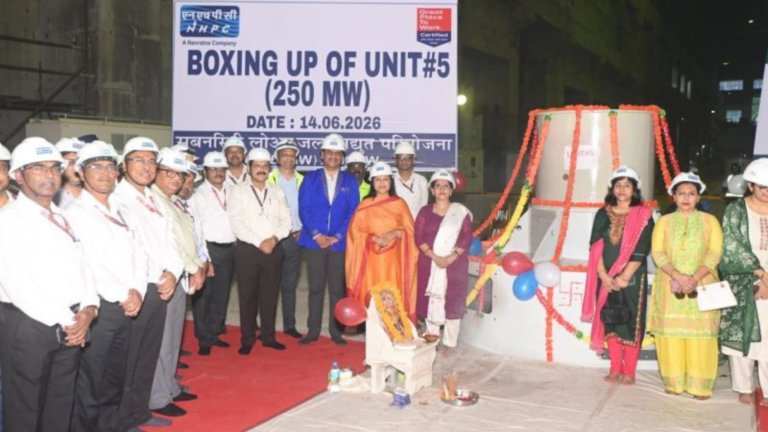
The 1 GW first phase of the Tehri Pumped Storage Project in Uttarakhand also recorded significant progress, with the first three 250 MW units commissioned between June and December 2025. Elsewhere, the 800 MW Parbati-II Hydroelectric Project in Himachal Pradesh entered full commercial operation in April, while the 240 MW Kutehr Hydroelectric Project was commissioned in August.
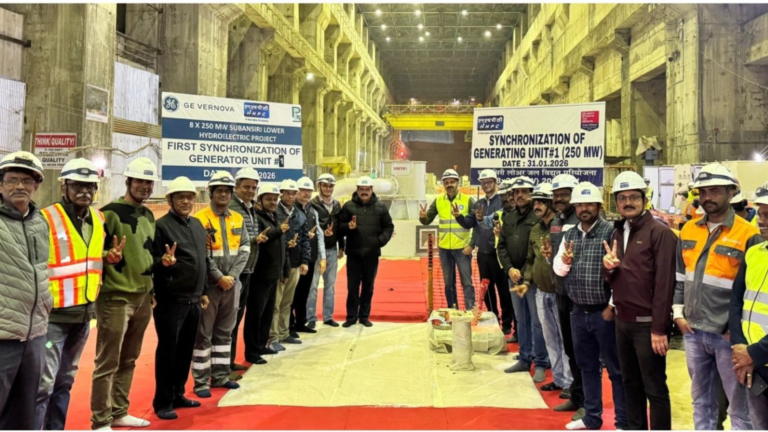
The Subansiri Lower Hydroelectric Project in Assam also entered operation, with electricity generation commencing in December 2025. By May 2026, four generating units with a combined capacity of 1,000 MW had been commissioned out of the project’s planned 2,000 MW capacity.
Policy momentum and strategic vision
India’s hydropower expansion is being supported by a series of policy reforms and long-term government targets. The Central Electricity Authority (CEA) has estimated the country’s pumped storage potential at nearly 288 GW, making it one of the largest untapped opportunities globally.
As of March 2026, around 16 GW of pumped storage projects were under construction, while Detailed Project Reports (DPRs) covering another 6.5 GW had already been appraised.
To accelerate project development, the Government of India has introduced several measures, including financial assistance for enabling infrastructure, waivers on Inter-State Transmission System (ISTS) charges for eligible projects, and faster approval timelines, with DPR processing reduced to 50 days. Regulatory reforms have also simplified approvals for off-stream pumped storage projects and eased certain concurrence requirements.
Additional incentives include relief from selected free power obligations, water cess payments and upfront royalties. The government is also examining viability gap funding mechanisms and electricity market reforms to better value services such as peak balancing, system flexibility and grid stability.
The pumped storage revolution
Pumped storage has emerged as the centrepiece of India’s long-duration energy storage strategy as renewable energy capacity continues to expand rapidly.
India’s installed solar PV capacity reached 150 GW as of March 2026 and is targeted to exceed 500 GW by 2035-36. During the same period, installed wind capacity is expected to grow from 56 GW to 155 GW. As renewable penetration increases, pumped storage is expected to play a critical role in balancing variable generation and maintaining grid stability.
The CEA has outlined a roadmap targeting 100 GW of pumped storage capacity by 2035-36, compared with the current installed capacity of just over 7 GW.
Development is being driven by both public and private sector investment. Major Indian companies, including Adani Group, Tata Power, JSW Energy, Torrent Power and Greenko, are advancing large pumped storage pipelines alongside state-owned utilities.
Several states, including Gujarat, Karnataka, Andhra Pradesh, Telangana, Tamil Nadu and Odisha, have introduced or are considering dedicated policies to accelerate pumped storage development.
The Brahmaputra basin alone has identified 64.9 GW of conventional hydropower potential together with 11.1 GW of pumped storage capacity as part of a broader strategy to integrate solar and wind energy, reduce renewable curtailment and strengthen system reliability.
Energy security and sovereignty
Beyond supporting decarbonisation, India’s hydropower strategy is increasingly linked to energy security and supply chain resilience.
Unlike certain battery technologies that rely heavily on imported raw materials, pumped storage projects can leverage domestic engineering capabilities, construction expertise and locally available materials. This reduces dependence on global supply chains while strengthening India’s domestic manufacturing ecosystem.
Hydropower also reduces reliance on imported fossil fuels for balancing power supply during peak demand, lowering exposure to fuel price volatility and geopolitical supply disruptions while improving long-term energy security.
Regional cooperation and integration
Hydropower is also becoming an important area of regional cooperation across South Asia.
India, Nepal and Bhutan are deepening collaboration in hydropower development and cross-border electricity trade, reflecting the growing integration of regional power systems.
Bhutan commissioned the 1.02 GW Punatsangchhu-II Hydropower Project during 2025, increasing the country’s installed hydropower capacity by approximately 40%. Construction also commenced on the 570 MW Wangchhu Hydropower Project, while Druk Green Power Corporation (DGPC) and Adani signed an agreement to jointly develop 5 GW of hydropower and pumped storage capacity.
Sustainability and international standards
Alongside capacity expansion, sustainability is receiving greater attention across the hydropower sector.
The Hydropower Sustainability Standard (HSS) is gaining wider acceptance as an international benchmark for environmental, social and governance performance. Financial institutions in Nepal are already using tools such as HydroSelect to strengthen ESG due diligence and investment decisions, reflecting a broader regional shift towards internationally recognised sustainability practices.
India in the global hydropower landscape
India’s expansion comes as hydropower enters a new phase of global strategic importance.
Worldwide installed hydropower capacity reached 1,469 GW by the end of 2025, comprising 1,269 GW of conventional hydropower and 201 GW of pumped storage. Global additions totalled 28 GW during the year, with pumped storage capacity surpassing 200 GW for the first time.
China remained the global leader, adding 4,670 MW of conventional hydropower and 7,480 MW of pumped storage capacity in 2025. The country accounts for more than 40% of global hydropower additions and currently has over 300 GW of hydropower under construction, including 217.5 GW of pumped storage.
Elsewhere, Ethiopia completed the 5 GW Grand Ethiopian Renaissance Dam, Africa’s largest power station, while Indonesia commissioned 1,129 MW of conventional hydropower capacity. The United States, Canada and several European countries continued to prioritise refurbishment, modernisation and pumped storage expansion rather than large conventional hydropower projects.
Globally, pumped storage capacity is expected to double over the next decade and could triple within 15 years, with annual additions projected to exceed 20 GW by 2030. India’s target of 100 GW of pumped storage by 2035-36 would account for a significant share of this global expansion and position the country alongside China as one of the principal drivers of future pumped storage deployment.
The global hydropower development pipeline currently stands at 1,127 GW, comprising 621 GW of pumped storage and 506 GW of conventional hydropower. More than 390 GW is already under construction, indicating a substantial increase in annual deployment over the coming decade.
Outlook
Hydropower remains the world’s largest source of renewable electricity, generating 4,495 TWh in 2025 while providing the flexibility, storage and ancillary services required to support modern power systems. India’s addition of more than 4 GW of new hydropower capacity in 2025, combined with its target of developing 100 GW of pumped storage by 2035-36, positions the country among the global leaders shaping the future of hydropower. As renewable energy capacity continues to expand, hydropower is expected to play an increasingly important role in ensuring grid stability, strengthening energy security and supporting India’s long-term decarbonisation objectives.