
Economic Survey 2025–26: Energy sector overview
The Department of Economic Affairs’ Economic Survey 2025–26 devotes significant attention to the evolution and strategic direction of India’s energy sector. It presents a multifaceted blueprint for the nation’s energy sector, with a focus on resilience, security, and sustainability.
Renewable energy expansion and associated challenges
The survey reiterates India’s commitment to scaling renewable energy while introducing a note of caution on resource intensity. It states that scaling renewables is also a materials, mining, and energy challenge. This reflects a more mature policy lens, acknowledging that the clean energy transition requires large volumes of raw materials, mining activity, and embedded energy for manufacturing solar panels, wind turbines, and batteries.
The survey argues for parallel strategies on sustainable material sourcing, recycling ecosystems under a circular economy framework, and energy efficiency improvements across manufacturing supply chains. These measures are positioned as essential to ensuring the sustainability of the transition itself.
Nuclear energy as a strategic baseload option
The survey elevates nuclear energy as a pillar of India’s clean and secure energy transition and outlines a dual-track approach. On capacity growth, the government has set a target of 100 GW of nuclear capacity by 2047, up from the current 8,780 MW.
On technology and institutions, the survey highlights the development of five indigenously designed Small Modular Reactors. The Union Budget 2025–26 has allocated Rs 20,000 crore for this programme, with a target for operationalisation by 2033. Small Modular Reactors are presented as a means to enhance energy security and provide flexible, low-carbon baseload power.
On the legislative front, the survey points to the SHANTI Act of December 2025 as a key reform. The Act enables private and state participation through a graded liability framework, safeguards victim compensation, and seeks to boost domestic manufacturing, research and development, and innovation. The survey frames this as a potential turning point for investment and deployment in the nuclear sector.
Energy storage as a grid enabler
Energy storage is described as a key enabler for renewable integration, peak management, and long-term resource adequacy. The survey estimates that India will require around 411 GWh of energy storage capacity by 2031–32.
To address this requirement, several policy measures are highlighted. Energy Storage Systems have been formally recognised under the Electricity Rules and included in the Harmonised Master List of Infrastructure, improving clarity for financing and project development.
Market-oriented measures include the waiver of Inter-State Transmission System charges for storage projects and the eligibility of storage assets to provide ancillary services, creating additional revenue streams.
On manufacturing and deployment, the survey cites a Rs 18,100 crore Production Linked Incentive scheme for 50 GWh of Advanced Chemistry Cell manufacturing and Viability Gap Funding schemes targeting around 43 GWh of Battery Energy Storage Systems.
Power distribution and financial performance
The survey highlights a sharp financial and operational turnaround in the power distribution sector. It notes that aggregate losses of Rs 67,962 crore in FY14 have shifted to a profit of Rs 2,701 crore in FY25.
Aggregate Technical and Commercial losses declined from 22.62% in FY14 to 15.04% in FY25. The survey attributes this improvement to sustained policy focus, financial restructuring programmes, and operational efficiency gains. It argues that a stronger distribution sector provides a more stable base for renewable integration and grid investment.
Regulatory streamlining and environmental governance
The survey outlines measures to improve regulatory predictability and reduce procedural delays for energy and infrastructure projects.
PARIVESH 3.0 has strengthened the single-window clearance system for environmental, forest, wildlife, and coastal regulation zone approvals, with greater emphasis on digital processing and post-clearance monitoring.
Nationwide uniform guidelines and amendments to the Air and Water Acts aim to simplify the Consent to Establish and Consent to Operate processes.
Under the Jan Vishwas Act, minor offences under several environmental laws, including the Environment Protection Act, 1986 and the Air Act, 1981, have been decriminalised. The stated objective is to shift regulatory focus from penalties to compliance.
The survey also notes the rationalisation of green belt norms, with requirements now linked to pollution potential rather than a uniform standard.
Sustainable finance and corporate disclosure
The survey traces the evolution of India’s green finance ecosystem from initial frameworks to more assurance-based reporting systems.
Frameworks for sovereign green bonds are in place, along with disclosure norms issued by the Securities and Exchange Board of India for listed green bonds.
The Reserve Bank of India has introduced a framework for green deposits, while SEBI has issued guidelines for broader environmental, social, and governance debt instruments.
Corporate reporting requirements have been strengthened through the Business Responsibility and Sustainability Reporting framework, which is mandatory for the top 1,000 listed companies. The introduction of BRSR Core requires assurance-based reporting on key indicators and expands value-chain disclosures, to improve data quality and reduce greenwashing.
Data-driven and climate-resilient planning
The survey highlights changes in sub-national climate planning through State Action Plans on Climate Change. Post-2020 plans are described as more adaptation-led, with state- and district-level climate risk assessments and closer integration with planning and finance departments.
The survey positions this granular, risk-informed approach as critical for developing energy infrastructure that can withstand climate-related stresses.
Conclusion: An integrated energy vision
The Economic Survey 2025–26 presents an integrated and forward-looking strategy for India’s energy sector. It combines ambitious renewable and nuclear targets with measures to address grid integration through storage, improve financial health through distribution reforms, and mobilise investment through regulatory clarity and green finance.
Security, resilience, and sustainability emerge as consistent themes. The survey frames this approach as essential to positioning India’s energy system as a foundation for long-term economic competitiveness and sustainable development.
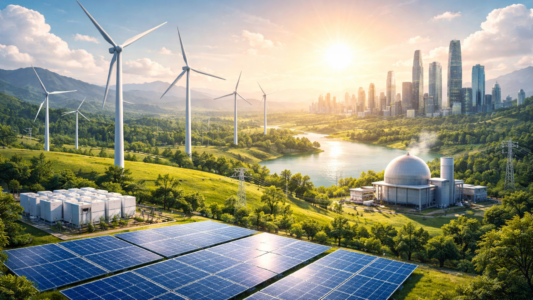
The featured photograph is for representation only.