
India’s transmission grid buildout: capacity growth and project pipeline
India’s national electrical transmission and distribution infrastructure shows sustained expansion, selective modernisation, and ongoing execution challenges. The Central Electricity Authority (CEA) data up to December 2025 highlights steady capacity additions, a strong intra-state buildout, and a growing project pipeline linked to renewable energy integration.
Transformation capacity overview
The cumulative transformation capacity for substations rated at 220 kV and above has reached 1,406,991 MVA. During FY 2025-26, up to December, 69,478 MVA was added. December alone accounted for 9,218 MVA. Most additions were concentrated in the 765 kV, 400 kV, and 220 kV AC systems.
In terms of composition, 765 kV systems account for 516,828 MVA, followed by 400 kV systems at 504,963 MVA and 220 kV systems at 351,700 MVA. HVDC capacity includes 18,000 MVA at ±800 kV, 13,500 MVA at ±500 kV, and 2,000 MVA at 320 kV. Together, the 765 kV and 400 kV systems represent over 72% of total national transformation capacity.
Historical data from the Sixth National Plan onwards shows that large-scale capacity additions began during the Ninth Plan period from 1997 to 2002, driven mainly by 220 kV infrastructure. The Tenth and Eleventh Plans saw strong expansion in both 220 kV and 400 kV systems. The introduction of ±800 kV HVDC technology during 2017–22 marked a strategic shift. Since March 2023, additions in some voltage categories have moderated, pointing to a consolidation phase.
Inter-State and Intra-State split
As of 31 December 2025, ISTS transformation capacity stands at 598,790 MVA, while Intra-State capacity is higher at 808,201 MVA. State-level grid development has therefore outpaced inter-state expansion. Overall transformation capacity has grown by a factor of 6.7 since March 2004. ISTS accounts for around 42.5% of the national total.
Progress against FY 2025-26 targets varies by sector and voltage level. In the 765 kV category, the Central Sector achieved 61.8% of its target, adding 31,500 MVA against a target of 51,000 MVA. The Private Sector achieved 56.3%. In the 400 kV category, the Private Sector led in percentage terms, while the State Sector added the highest absolute capacity. For 230 kV and 220 kV infrastructure, the Central Sector met 100% of its 320 MVA target, while the State Sector achieved about 54% of its larger target.
Transmission lines and inter-regional capacity
The total length of transmission lines at 220 kV and above has reached 499,451 circuit km. Inter-regional transmission capacity now stands at 120,340 MW. During December 2025, 1,436 circuit km were added, taking cumulative additions in FY 2025-26 to 5,077 circuit km.
Inter-regional capacity expanded from 6,550 MW during the Ninth Plan to 27,150 MW by the end of the Eleventh Plan in 2012, and further to 75,050 MW by 2017. Growth between 2017 and December 2025 exceeds 60%. As of 31 December 2025, ISTS transmission lines total 216,348 circuit km, while Intra-State lines account for 283,103 circuit km.
Against an FY 2025-26 target of 15,382 circuit km, 6,961 circuit km were achieved by December, or 45.25% completion within three quarters. The Private Sector achieved 69.57% of its target, followed by the State Sector at 44.12% and the Central Sector at 32.14%.
Voltage-wise, overall achievement for 765 kV lines is 15.33%. The Central Sector achieved 44.44% of its target, while the State Sector reported no additions. For 400 kV lines, overall achievement stands at 51.04%, with the Central Sector exceeding its target at 140.68%. For 230 kV and 220 kV lines, overall achievement is 45.77%, again supported by Central Sector overperformance.
Project pipeline and execution challenges
As of December 2025, 84 projects are under execution through the TBCB route, with an estimated cost of Rs 2,36,421 crore. These projects aim to add 37,994 circuit km of lines and 320,000 MVA of transformation capacity. Power Grid Corporation of India Limited is implementing 43 projects, while private developers are executing 41.
Most TBCB projects focus on renewable energy evacuation from states such as Rajasthan, Gujarat, Karnataka, and Andhra Pradesh. Others are aimed at inter-regional strengthening through new HVDC links and AC corridors, along with support for nuclear power evacuation and substation augmentation.
The December 2025 monthly progress report highlights recurring constraints. These include delays in land acquisition, forest clearances at both Stage I and Stage II, Right of Way disputes linked to compensation and local resistance, and regulatory delays such as pending transmission licences and tree-cutting permissions.
In parallel, 80 projects are under construction under the Regulated Tariff Mechanism, with a total investment of Rs 50,973 crore. These projects target 2,807 circuit km of lines and 79,255 MVA of transformation capacity. Power Grid Corporation of India Limited is executing 75 of these projects. Many RTM projects are linked to renewable energy zones in Rajasthan, Gujarat, Leh-Ladakh, Andhra Pradesh, and Tamil Nadu. While some face delays due to Right of Way or weather-related issues, others are nearing completion. Several remain at tendering or early execution stages, with timelines extending to 2026 and 2027.
Looking ahead, large projects with targets beyond 2027 include the Leh–Kathal 5 GW transmission corridor, scheduled for completion by March 2031, and offshore wind integration projects in Tamil Nadu and Gujarat with targets in 2029 and 2030. The Central Electricity Authority notes that the data is indicative and does not dilute contractual obligations.
Overall, India’s high-voltage transmission infrastructure shows continued expansion, with transformation capacity exceeding 1.4 million MVA and transmission lines nearing 500,000 circuit km. Growth remains strongest in the 765 kV and 400 kV systems, supported by selective HVDC deployment. Intra-State networks hold a larger capacity share than ISTS. Progress against annual targets is uneven, and while the project pipeline is large and renewable-focused, land, clearance, and Right of Way issues continue to shape execution risks.
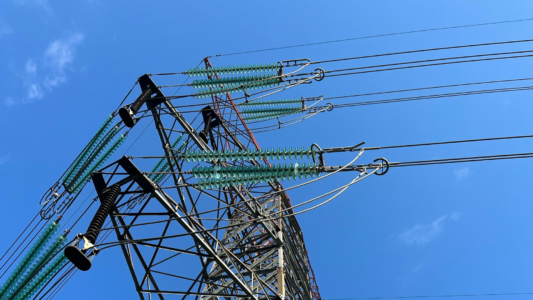
The featured photograph is for representation only.